6 Reasons Your Arm Training Stalled, and the Specific Change for Each
Quick Answer: Arm stalls almost always trace to one of six things: too little total volume, too much volume with no recovery, no progressive overload, all the work at one joint angle, the bigger lifts crowding out arm work, or protein and sleep failing underneath everything. Identify which one applies before changing your program - adding sets to an over-volume problem or adding intensity to a recovery problem both make it worse. Most stalls resolve within four to six weeks once the right variable moves.
Arms are one of the more responsive areas to train, which is why hitting a wall with them feels so personal.
Six causes, six different fixes, and picking the wrong one costs you a training block.

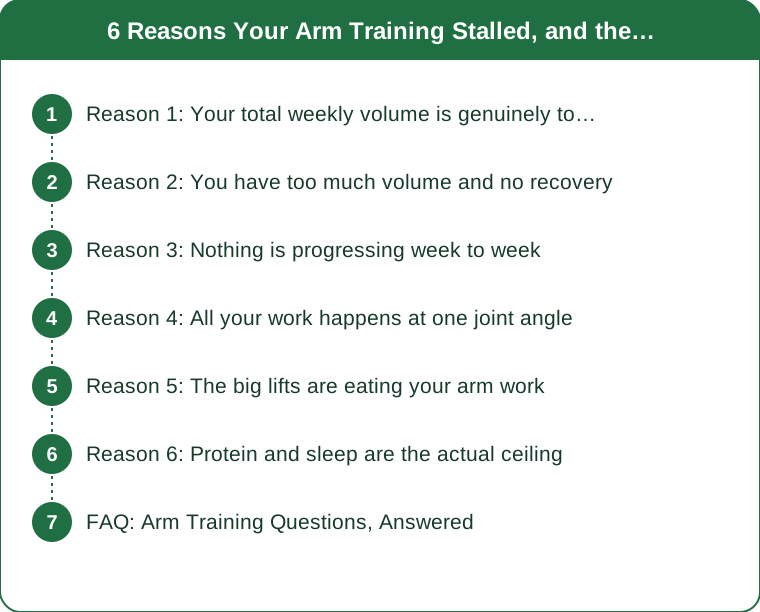
Reason 1: Your total weekly volume is genuinely too low
Arms attached to a bench press are not the same as arms trained.
A common pattern: two or three sets of curls tacked onto the end of a session, once a week. That is three working sets weekly. Research on hypertrophy generally points toward roughly 10-20 hard sets per muscle group per week for meaningful growth, and biceps and triceps are no exception.
The fix is not a marathon arm day. Spread the volume across two or three sessions - six sets of biceps work twice a week reaches 12 sets, and frequency of two to three times weekly tends to outperform once weekly at matched volume.
How to tell this is your problem: you can count your weekly arm sets on one hand, and you finish arm work feeling like you could have done considerably more.
Reason 2: You have too much volume and no recovery
The opposite failure, and it looks similar from the outside because both produce no progress.
Arms are small muscles that also assist in every pressing and pulling movement you do. If you row and press four times a week and then add 20 direct arm sets, total stimulus can exceed what you recover from - particularly at the elbow, where tendons take longer to adapt than muscle.
Signs this is you: persistent elbow soreness, arm work feeling flat rather than challenging, grip failing early, and performance drifting down rather than sideways.
The fix is a deload - cut arm volume by half for a week, then rebuild to about 70% of what you were doing. Counterintuitively, many people see their best arm progress in the weeks after cutting volume, because they were sitting past the point where more stopped helping.
Reason 3: Nothing is progressing week to week
Doing the same three sets of 12 with the same dumbbells for six months is maintenance, not training - and it is the most common stall of all.
Progressive overload does not have to mean heavier every week, which is unrealistic on small muscles. Any of these count:
- More reps at the same weight
- More sets at the same weight and reps
- Slower eccentrics - a three-second lowering phase is meaningfully more work than a one-second one
- Less rest between sets at matched load
- Better range of motion - a fuller stretch position is a genuine progression
Write down what you did. This sounds trivial and it is the single highest-return habit for arm training specifically, because the increments are small enough that memory cannot track them reliably.
How to tell: you cannot say what weight and reps you used last week.

Reason 4: All your work happens at one joint angle
Biceps and triceps both cross the shoulder as well as the elbow, which means the position of your upper arm changes which portion of the muscle does the work.
For triceps, the long head is the largest of the three and it only gets fully stretched when your arm is overhead. If your entire triceps program is pushdowns with elbows at your sides, the long head is undertrained - and that is the head that contributes most to arm size.
For biceps, the long head is more involved when the arm is behind the body (incline curls) and less so when the arm is in front (preacher curls).
The fix is one movement from each position:
- Triceps: one overhead extension plus one pushdown
- Biceps: one incline or behind-the-body curl plus one standing or preacher curl
How to tell: your program has three triceps exercises and all three are variations of a pushdown.
Reason 5: The big lifts are eating your arm work
If arm training is always last, always after a heavy session, and always when you are already depleted, it gets the leftovers.
This matters more than it sounds. The quality of a set - how much genuine effort you can produce - drops substantially when you are fatigued. Twelve sets performed depleted are not equal to twelve fresh sets.
Two practical fixes:
Move arms to the front of a session once a week. Not every session - a single arm-priority day where they get your best effort.
Or give them their own short session. Twenty minutes, two or three times a week, separate from your main training. Arms recover fast enough to support this, and short sessions are easy to fit in.
How to tell: your arm work always happens in the last ten minutes and you sometimes skip it when you are short on time. That skipping is data - it tells you where arms actually sit in your priority order.
Reason 6: Protein and sleep are the actual ceiling
No arm program out-trains a 60g protein day and six hours of sleep.
Muscle growth needs material and it needs recovery. Common guidance for people training for hypertrophy sits around 1.6-2.2g of protein per kilogram of bodyweight daily, distributed across meals. Many people training seriously eat considerably less than the lower end of that and never connect it to their stalled progress.
Sleep matters at least as much. Growth hormone release is concentrated in deep sleep, and short sleep is associated with reduced muscle protein synthesis and worse training performance. Chronically sleeping six hours while running a demanding program is a limiting factor no amount of exercise selection will fix.
How to tell: you can name your training split precisely but not your average daily protein intake or your average sleep duration. If the training variables are the only ones you can quantify, that is where the gap probably is.
Fix this one first if it applies, because the other five fixes all depend on it working.
FAQ: Arm Training Questions, Answered
How often should I train arms?
Two to three times a week generally beats once, at the same total weekly volume. Splitting 12 sets into two sessions of six lets you bring better effort to each and manages elbow fatigue better than one long session.
Do I need heavy weights for arms?
Not particularly. Hypertrophy occurs across a broad rep range - roughly 5 to 30 reps - as long as sets are taken close to failure. For arms specifically, moderate weights in the 8-15 range with good control tend to work better than heavy loads, largely because form deteriorates and the elbow takes the difference.
Why do my arms look bigger some days than others?
Muscle glycogen and water shift with carbohydrate intake, sodium, and recent training. A pump after a session can persist for a day or two. This is normal fluctuation and tells you nothing about progress - which is why measuring monthly under consistent conditions is more useful than looking in the mirror daily.
How long before I should expect visible change?
With consistent training and adequate protein, most people notice measurable change in 8-12 weeks and visible change somewhat later. Arms are a small area, so a genuinely meaningful gain is often less than an inch. Tape measurements monthly beat mirror checks daily. This is general information, not medical advice.
TL;DR:
- Diagnose before you change. Adding volume to an over-volume problem makes it worse.
- Too little volume: aim for 10-20 hard sets per muscle per week, split across two or three sessions.
- Too much: deload by half for a week, rebuild to ~70%. Elbow soreness is the tell.
- No progression: log your sets. Reps, sets, tempo, and range all count as overload.
- One joint angle: add an overhead triceps movement and a behind-the-body curl.
- Arms always last: give them a priority slot or a short standalone session.
- Protein and sleep are the floor. If you can name your split but not your protein intake, start there.
The useful part of this list is that the six causes rarely overlap - one of them is usually clearly yours. Fix that one variable, hold everything else steady for four to six weeks, and you will know whether you diagnosed it correctly. This is general information, not medical advice.
Keep Reading
This article is for general informational and styling purposes only. Fit, sizing, and product availability may vary.