7 Changes Worth Making to Your Arm Training This Autumn
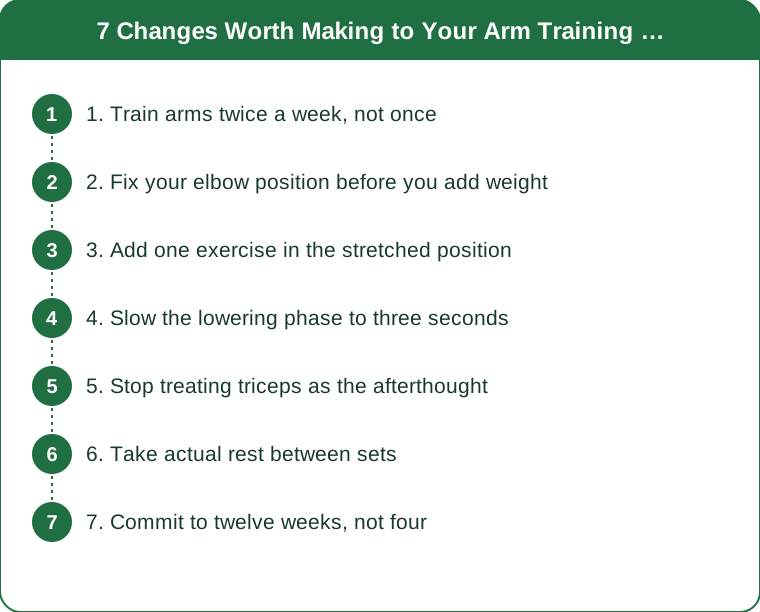
Quick Answer: Autumn is the best arm-training season of the year — indoor consistency, cooler temperatures, and a long uninterrupted block before the holidays. The seven changes that matter most: train arms twice a week instead of once, fix your elbow position before adding weight, add a stretched-position exercise, slow the lowering phase, stop treating triceps as an afterthought, take real rest between sets, and pick a twelve-week horizon instead of a four-week one.
Summer arm training is fragmented. Travel, heat, sessions that get cut short, a schedule with no shape.
What you have now is the opposite: a stable indoor routine, cooler air, and roughly twelve uninterrupted weeks before December scrambles everything. That’s enough time to actually change something. Here are the seven changes worth making.

1. Train arms twice a week, not once
The single highest-return change on this list.
Most people train arms once a week, usually tacked onto the end of another session when they’re already tired. The research on training frequency points consistently in one direction: for a given weekly volume, splitting it across two sessions generally produces equal or better results than putting it all in one.
The mechanism is straightforward. Muscle protein synthesis after a training session is elevated for roughly 24 to 48 hours and then returns to baseline. Training a muscle once a week means five days a week where nothing is being stimulated.
What this looks like practically: if you currently do six sets of biceps and six of triceps in one session, do three and three, twice a week instead. Same total volume, no extra time, meaningfully better outcome.
The second session doesn’t need to be a full workout. Fifteen minutes attached to a lower-body day works fine.
2. Fix your elbow position before you add weight
The most common reason arm training stops producing results isn’t the load. It’s that the elbow drifts.
On a curl, the elbow should stay roughly fixed in space while the forearm rotates around it. What actually happens as fatigue builds: the elbow travels forward, the shoulder starts flexing, and the front delt takes over the top half of the movement. The rep still happens. The biceps stop being the limiting factor.
The same thing happens in reverse on triceps work — the elbows flare out and the shoulder contributes.
How to check without a coach: film one set from the side. Not a mirror, which is a front view and hides this entirely. Watch where the point of your elbow is at the bottom, middle, and top. If it moves more than a couple of inches, you have your answer.
The fix is almost always less weight and more attention, which nobody wants to hear. A curl done with a fixed elbow at 15 pounds does more than a curl with a drifting elbow at 25.
3. Add one exercise in the stretched position
This is the change that people who already train arms consistently most often haven’t made.
A growing body of evidence suggests that training a muscle in its lengthened position produces more growth than training it in the shortened position, when volume is matched. For the biceps, that means exercises where the arm is behind the body and the muscle is under tension at long length.
Concretely:
- Incline dumbbell curls — lying back on a bench at roughly 45 to 60 degrees, arms hanging behind the torso. The bottom position is where the work happens.
- Behind-the-body cable curls for the same reason.
- For triceps, overhead extensions — the long head is stretched when the arm is overhead, and it isn’t in a pushdown.
If you currently do curls standing and triceps pushdowns, you are training both muscles almost entirely in the shortened and mid-range positions. Swapping one exercise in each for a stretched-position version is a small change with a disproportionate return.

4. Slow the lowering phase to three seconds
The lowering — the eccentric — is where a large share of the growth stimulus lives, and it’s the part most people rush.
A typical set looks like a one-second lift and a half-second drop. Half the reps’ potential is being discarded because gravity is doing the work.
The change: three seconds down, controlled, on every rep. Not slow to the point of theater, just genuinely controlled. Count it.
Two things happen immediately. First, you’ll need less weight, which is uncomfortable and fine. Second, sets that felt easy at ten reps become hard at eight, which tells you how much you were giving away.
There’s a practical bonus for autumn specifically: slower eccentrics let you get a strong stimulus from lighter loads, which matters if you’re training at home or in a busy gym where the dumbbells you want are never free.
One caveat — very slow eccentrics produce more soreness in the first two weeks. Start with the change on one exercise, not all of them.
5. Stop treating triceps as the afterthought
The triceps are roughly two-thirds of your upper arm by mass. Most people give them a third of their arm training attention, usually at the very end of a session when they’re depleted.
If the goal is arms that look different, the triceps are the higher-leverage target, and it isn’t close.
What to change:
- Train triceps first in at least one of your two weekly arm sessions. The order effect is real — whatever you do first gets your best effort.
- Include an overhead movement, as covered above, because the long head is the largest of the three heads and it’s undertrained by pushdowns alone.
- Include one heavier compound-ish movement — close-grip pressing, dips, or a bench variation — rather than only isolation work.
A reasonable weekly structure: two triceps exercises twice a week, one overhead and one pressing or pushing, three sets each. That’s more triceps volume than most people do in a month.
6. Take actual rest between sets
This is the change that costs nothing and gets ignored most.
Rest periods for hypertrophy work are commonly cut to 30 or 45 seconds under the belief that shorter rest means a better workout. What shorter rest actually produces is fewer reps at a given load on subsequent sets — meaning less total work done, which is the opposite of the goal.
The evidence points toward 90 seconds to two minutes between sets for isolation work being better for growth than 30 to 60 seconds, largely because you can maintain the load.
For arms specifically, where sets are short and the muscle is small, 90 seconds is a reasonable target. If your set of curls goes 12, 9, 6, your rest is too short — the drop-off should be one or two reps, not six.
The practical trade: three well-rested sets beat five rushed ones, and they take about the same amount of time.
7. Commit to twelve weeks, not four
The last change is about horizon, and it’s the one that determines whether the other six matter.
Visible change in arm size and definition operates on a timescale most people badly underestimate. Meaningful, visible change in a trained individual takes months, not weeks. A four-week block produces measurable strength gains and almost no visual change, which is why four-week attempts feel like failures and get abandoned.
What twelve weeks gets you: enough time for actual tissue change, enough sessions to progress load meaningfully, and enough repetition for technique to become automatic.
What to do concretely:
- Write down your starting numbers. Weight and reps for two or three key exercises. This is the only honest measure of progress in a period where the mirror won’t show much.
- Progress one variable at a time — add a rep before you add weight, and add weight only when you hit the top of your rep range on all sets.
- Take a lighter week around week seven. Not a break, just reduced volume. It’s the difference between finishing the block and stalling in week nine.
- Photograph, don’t just look. Same lighting, same time of day, every three weeks. Day-to-day mirror checks are noise.
The seasonal argument: starting now puts week twelve in mid-November, before the holidays disrupt everything. Starting in January puts it against the worst weather and the most crowded gyms of the year. This is the good window.
If you have current elbow or shoulder pain, get it looked at before adding volume — arm training is one of the easier places to aggravate a tendon issue. This is general information, not medical advice.
TL;DR:
- Twice a week beats once, with the same total volume split across two sessions.
- Film a set from the side and fix elbow drift before you touch the weight.
- Add one stretched-position exercise per muscle — incline curls, overhead extensions.
- Three seconds down on every rep. Lighter load, better stimulus.
- Triceps are two-thirds of the arm. Train them first at least once a week and include an overhead movement.
- Rest 90 seconds to two minutes. If reps drop by six between sets, you’re resting too little.
- Commit to twelve weeks, write down starting numbers, and take a lighter week around week seven.
You have one clean uninterrupted block between now and the holidays. It’s the best arm-training window of the year — use the whole thing.
Keep Reading
This article is for general informational and styling purposes only. Fit, sizing, and product availability may vary.