6 Arm Exercises Doing Less Than You Think - and What to Swap In
Quick Answer: The most common underperforming arm exercises are tricep kickbacks, standing dumbbell tricep extensions with too little weight, high-rep tiny-dumbbell circuits, unloaded arm circles, cable pushdowns done with the shoulders, and concentration curls performed with momentum. In each case the problem is where resistance peaks relative to where the muscle is strongest, or a load too light to matter. The swaps below keep the movement pattern and fix the loading.
You are doing arm work three times a week and nothing much is happening. The exercises are not fake - they are just being asked to do a job their mechanics do not support.

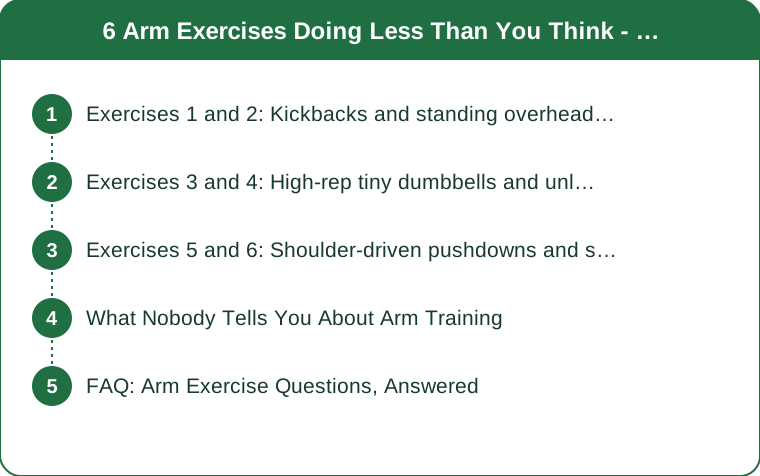
Exercises 1 and 2: Kickbacks and standing overhead extensions
1. Tricep kickbacks
The problem is where the resistance peaks. In a kickback, gravity provides maximum resistance when your forearm is horizontal - which happens at the very end of the movement, where the triceps are already shortened and mechanically weakest. Through the first two-thirds of the range, where the muscle could handle real load, there is barely any.
The result is a large range with almost no useful tension. You feel a sharp burn at the top because you are working the muscle at its weakest point, and the burn gets mistaken for effectiveness.
Swap in: overhead cable or band extensions. Same triceps, but the resistance is highest when the arm is overhead and the long head of the triceps is stretched - which is where the muscle can produce force and where stretch-position loading appears to be most productive.
2. Standing overhead extensions with a weight that is too light
The exercise is good; the load usually is not. Overhead extension is one of the best triceps movements available because it loads the long head in a lengthened position. The problem is that most people select a weight based on what feels controllable overhead while standing, which is well below what the triceps can handle.
Stability is the limiter, not the muscle. Standing means your core and shoulders are stabilizing a weight above your head, and that system fails long before the triceps do.
Swap in: seated with back support, or a cable version. Removing the stability demand lets you load the triceps properly. Most people can use considerably more weight seated with a back rest than standing, and that difference is the entire training effect.
Exercises 3 and 4: High-rep tiny dumbbells and unloaded arm circles
3. High-rep circuits with two-pound dumbbells
Muscle adapts to progressive tension, and two pounds does not provide it for most people. If you can perform 40 repetitions of anything, the load is far below what drives adaptation. The burning sensation is metabolic, and it is not a reliable indicator that a useful stimulus occurred.
This is not an argument for heavy-only training. Research suggests hypertrophy occurs across a wide rep range, roughly 5 to 30 repetitions, provided sets are taken close to failure. The problem with two-pound circuits is not the reps - it is that they end well before that point because the class moved on.
Swap in: the same movements at 8 to 15 reps with a load that makes the last two or three genuinely hard. For most women starting out, that is 8 to 15 pound dumbbells for curls and extensions, not two.
4. Unloaded arm circles for toning
They are a warm-up, and a decent one. Arm circles increase blood flow and shoulder mobility, and they are entirely appropriate before training.
They are not a strength stimulus. The load is the weight of your arm, which your shoulders already move constantly all day. The burning after 60 seconds is fatigue in small stabilizers, not a signal of adaptation in the muscles you want to change.
Swap in: keep them as a warm-up, then do actual loaded work. Lateral raises with 5 to 12 pounds for 10 to 15 reps do what people hope arm circles are doing.
And note the general principle underneath both of these: spot reduction is not a mechanism. Arm exercises build the muscle underneath; the visible definition depends on overall body composition, which is driven by total training and nutrition rather than by arm-specific volume.

Exercises 5 and 6: Shoulder-driven pushdowns and swung concentration curls
5. Cable pushdowns performed with the shoulders
The exercise is fine; the execution usually is not. A pushdown should be pure elbow extension with the upper arm fixed at the side. What most people do is lean forward and drive down through the shoulders and lats, converting a triceps isolation into a poorly-executed compound movement.
The giveaway is the elbows drifting forward and back. If your upper arm changes angle during the set, the lats are contributing and the triceps are getting less than the weight suggests - which is why people can pushdown far more than they can extend overhead.
Swap in: same exercise, elbows pinned, lighter. Set the weight so you can keep the upper arms genuinely stationary for all reps. Most people drop 20 to 30 percent and feel considerably more in the triceps.
6. Concentration curls with momentum
The whole premise is strict positioning, and momentum destroys it. Bracing the elbow against the thigh is meant to eliminate swing. Once you start heaving the weight up and letting it drop, you have kept the awkward seated position and lost the only benefit it provided.
The lowering phase is where the value is. Eccentric loading is a significant contributor to hypertrophy, and dropping the weight in half a second wastes it entirely.
Swap in: any curl variation with a controlled three-second lowering phase. Incline dumbbell curls are particularly effective because the arm sits behind the body, loading the biceps in a stretched position - which is the same principle that makes overhead triceps work well.
The pattern across all six: load the muscle where it is strong and lengthened, control the lowering, and use a weight that makes the last few reps hard. That is the whole of it.
What Nobody Tells You About Arm Training
Your arms already get substantial work from compound lifts. Rows and pulldowns load the biceps heavily; presses and dips load the triceps. If you strength train, direct arm work is a supplement to that, and 6 to 10 hard sets per muscle per week on top is plenty for most people.
Triceps are roughly two-thirds of your upper arm. Most arm-focused programs are curl-heavy, which is backwards if the goal is the shape of the arm rather than the bicep specifically.
The long head of the triceps only gets fully loaded overhead. It crosses the shoulder joint, so it is only in a stretched position when the arm is raised. Any program with no overhead triceps work is missing the largest head of the largest muscle in the arm.
Soreness is a poor progress metric. Novel exercises cause soreness; effective ones cause adaptation. These overlap only loosely, and chasing soreness reliably leads people toward high-rep burn work and away from progressive loading.
Progression has to be written down. Arm work is where people are least likely to track anything, which is exactly why it is where plateaus go unnoticed for months. Same weight, same reps, three months running is the single most common reason arm training does nothing.
And the timeline is longer than the marketing suggests. Visible change in arm shape typically takes months of consistent progressive work plus attention to overall body composition. That is not discouraging - it is just the actual timescale, and knowing it prevents people from abandoning a working program at week five.
FAQ: Arm Exercise Questions, Answered
Are tricep kickbacks a waste of time?
They are not useless, but resistance peaks where the triceps are shortest and weakest, so most of the range carries almost no tension. Overhead cable or band extensions load the same muscle where it is stretched and strong, which is the more productive position.
How heavy should my dumbbells be for arm exercises?
Heavy enough that the last two or three reps of a set of 8 to 15 are genuinely hard. For most women that means 8 to 15 pound dumbbells for curls and extensions rather than the 2 to 5 pound weights used in high-rep classes.
Why are my arms not changing despite regular arm workouts?
Usually because the load has not increased in months, the sets stop well short of challenging, or the program is curl-heavy while triceps make up about two-thirds of the upper arm. Visible definition also depends on overall body composition, not on arm-specific volume.
Do I need direct arm work if I already lift?
Rows and presses already load the biceps and triceps substantially, so direct work is a supplement. Six to ten hard sets per muscle per week on top of compound training is sufficient for most people.
What is the best tricep exercise?
An overhead extension variation, because the long head crosses the shoulder and is only fully lengthened when the arm is raised. Seated with back support or on a cable lets you load it properly without the standing stability limitation.
TL;DR:
- Kickbacks load the triceps only where they are shortest and weakest - swap to overhead extensions that load the stretched position.
- Standing overhead extensions are limited by stability, not by the triceps; go seated with back support or use a cable.
- Two-pound high-rep circuits and unloaded arm circles are warm-ups, not stimuli - use 8 to 15 reps with a genuinely hard last few.
- Pushdowns done with a moving upper arm become a lat exercise; pin the elbows and drop the weight 20 to 30 percent.
- Control the lowering phase for three seconds; eccentric loading is a real driver of growth and dropping the weight wastes it.
- Triceps are about two-thirds of your upper arm, and the long head only loads fully overhead - most programs are curl-heavy and miss it.
None of these six are junk. They are just being run in a position or at a load where the muscle never quite gets the message - and every one of them has a swap that fixes it without changing your routine much at all.
Keep Reading
This article is for general informational and styling purposes only. Fit, sizing, and product availability may vary.