7 Signs You're Overtraining Your Arms (And What to Do About Each One)
Quick Answer: Persistent joint ache (not muscle soreness), declining grip strength, and arm workouts that stop producing any pump at all are among the clearest overtraining signs — the fix in most cases is a deload week, not pushing through with more volume.
Arm training responds well to consistency, which makes it tempting to add more sets whenever progress stalls. Often that’s exactly backwards — these seven signs point to needing less, not more.

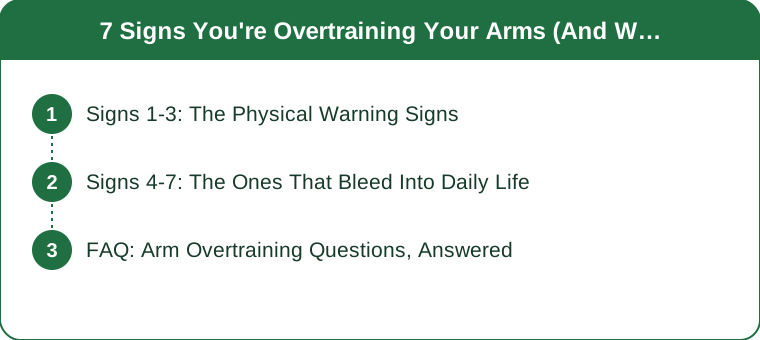
Signs 1-3: The Physical Warning Signs
1. Joint ache that doesn’t match muscle soreness
Normal muscle soreness sits in the belly of the muscle and fades within 48-72 hours. Persistent elbow or wrist ache, especially one that lingers past a normal recovery window, points toward tendon strain from accumulated volume rather than typical training soreness.
2. Grip strength quietly declining
A noticeable drop in how much weight you can grip and hold — even in exercises unrelated to direct arm training — is a reliable early overtraining marker, since grip strength is sensitive to overall nervous system fatigue.
3. Workouts stop producing any pump
If arm workouts that used to reliably produce a strong pump start feeling flat regardless of effort, that’s often a sign of accumulated fatigue blunting blood flow response, not a sign you need to train harder to force it.

Signs 4-7: The Ones That Bleed Into Daily Life
4. Sleep quality drops on heavy arm training days
Overtraining affects the nervous system broadly, and disrupted sleep following intense sessions is a common, often overlooked signal — particularly difficulty falling asleep despite feeling physically tired.
5. Small tasks start feeling harder
Carrying groceries, opening jars, or typing for long stretches feeling unusually fatiguing points to accumulated fatigue bleeding into daily function, beyond what normal training soreness explains.
6. Motivation to train arms specifically drops
A sudden drop in motivation for a muscle group you normally enjoy training, while motivation for other muscle groups stays normal, can be a psychological overtraining signal worth taking as seriously as the physical ones.
7. Progress plateaus or reverses despite consistent effort
If strength or pump quality is going backward despite unchanged or increased effort, more volume is very unlikely to be the fix — this is the clearest sign a deload week (roughly half the usual volume) is overdue.
FAQ: Arm Overtraining Questions, Answered
How long should a deload week for arms typically last?
One full week at roughly 40-50% of normal volume is a common approach, followed by a gradual return to full training load.
Can overtraining happen even while other muscle groups are recovering fine?
Yes — overtraining can be localized to a specific muscle group that’s been trained more frequently or intensely than the rest of the body.
Is joint ache from overtraining ever a sign of something more serious?
Persistent joint pain that doesn’t improve with rest and a deload is worth a medical evaluation rather than continued self-management — this is general information, not medical advice.
TL;DR:
- Joint ache, declining grip strength, and a disappearing pump are clearer overtraining signals than general tiredness
- Sleep disruption and reduced motivation for one muscle group specifically can be early signs
- Progress plateaus or reversals despite consistent effort usually call for a deload, not more volume
- This is general information, not medical advice — persistent joint pain warrants professional evaluation
More arm volume isn’t always the answer to stalled arm progress — sometimes the honest fix is less, for a week.
Keep Reading
This article is for general informational and styling purposes only. Fit, sizing, and product availability may vary.