7 Reasons Your Arm Workout Still Isn't Toning Your Arms
Quick Answer: Arm workouts often fail to visibly tone arms because of too-light weight, missing progressive overload, or overlooked body fat percentage in that specific area — not because the exercises themselves are wrong.
You’ve done the same arm circuit three times a week for two months. Your arms feel a little stronger, but they don’t look any different in the mirror. Here are the 7 most common, overlooked reasons that happens.

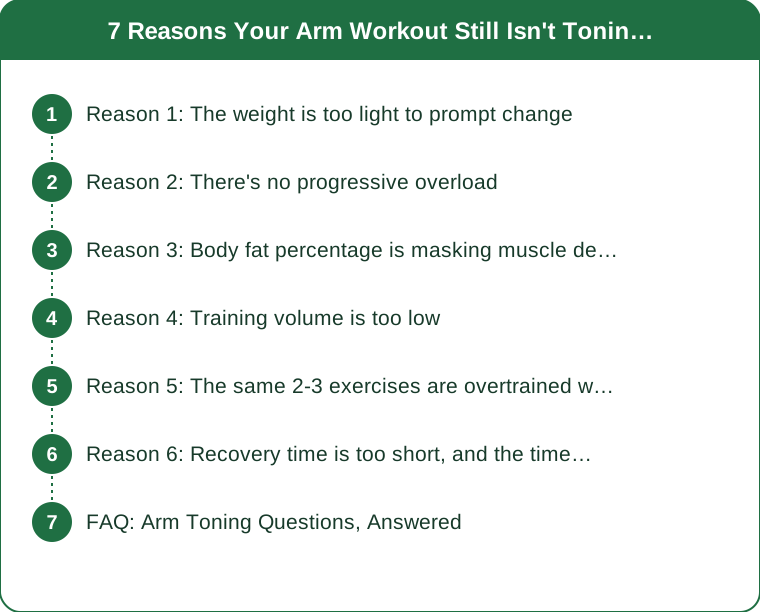
Reason 1: The weight is too light to prompt change
Toned appearance comes from a combination of muscle definition and lower fat covering it — both require enough resistance to actually challenge the muscle. If your last few reps never feel hard, the weight isn’t heavy enough to build the muscle that creates visible tone.
Reason 2: There’s no progressive overload
Using the same weight for the same reps for months gives your muscles no reason to adapt further after the first few weeks. Small, steady increases in weight or reps every 2-3 weeks are what keep progress moving.
Reason 3: Body fat percentage is masking muscle definition
Arm muscle can genuinely be growing while still being covered by enough fat that visible definition doesn’t show yet. This is a nutrition and overall body composition factor, not a sign the arm exercises themselves aren’t working.

Reason 4: Training volume is too low
A quick 10-minute arm circuit twice a week is rarely enough total volume to build visible muscle. Most noticeable change requires consistent, adequate volume — generally multiple sets across each major arm muscle group, several times weekly.
Reason 5: The same 2-3 exercises are overtrained while others are ignored
Curls alone build biceps but leave triceps, which make up more of the arm’s visual bulk, undertrained. A balanced routine hitting biceps, triceps, and shoulders creates a more complete visual change than isolating one muscle repeatedly.
Reason 6: Recovery time is too short, and the timeline is shorter than you think
Muscle growth happens during recovery, not during the workout itself. Training the same arm muscles daily without adequate rest can actually slow visible progress compared to a schedule with 48 hours between sessions.
On top of that, visible muscle tone changes typically take 8-12 weeks of consistent, appropriately challenging training to become clearly noticeable — two months is close to the early end of that window, not a sign of failure.
FAQ: Arm Toning Questions, Answered
How long does it actually take to tone arms?
Most people need 8-12 weeks of consistent, progressively challenging training to see a clear visual change, sometimes longer depending on starting point.
Do I need heavy weights to tone arms, or is light weight with high reps enough?
Either can work if it’s genuinely challenging by the last few reps — the key variable is effort and progressive overload, not a specific weight range.
Does diet matter more than the workout for toned arms?
Both matter. Muscle needs training to grow, and body fat needs to be low enough in that area for definition to show — neither alone is usually sufficient.
TL;DR:
- Too-light weight and missing progressive overload are the most common culprits
- Body fat percentage can hide real muscle progress underneath
- Balanced training across biceps, triceps, and shoulders beats isolating one muscle
- Give it 8-12 weeks of consistent, challenging training before judging results
If your arm workout still isn’t showing results, check these 7 factors before assuming the exercises themselves are wrong.
Keep Reading
This article is for general informational and styling purposes only. Fit, sizing, and product availability may vary.