7 Reasons Your Push-Ups Are Not Building Your Arms
Quick Answer: Push-ups load the chest and front shoulder far more than the arms, and the triceps only get a meaningful share when the elbows stay close to the body and you go through a full range. The seven usual culprits are flared elbows, partial range, too-easy variation, no progression, too few sets, no biceps work at all, and doing them every single day. Fix the elbow position and the range first - together they account for most of the problem.
The push-up is an excellent exercise. It is just answering a different question than the one you asked.

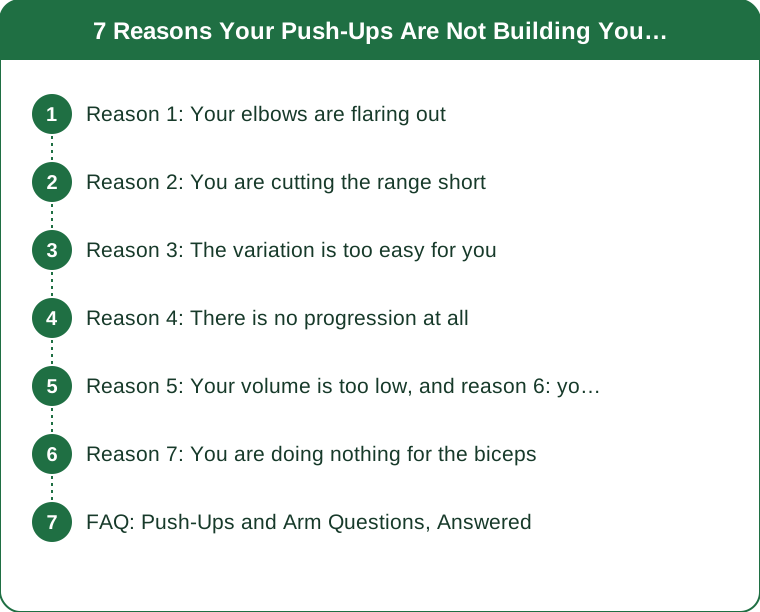
Reason 1: Your elbows are flaring out
This is the single biggest one, and it changes which muscle does the work.
When your elbows flare to roughly 90 degrees from your body, the movement becomes a chest press with a wide grip. The pectorals dominate, the front shoulder takes a large share, and the triceps contribute relatively little.
Tuck the elbows to around 45 degrees from your torso and the mechanics shift substantially toward the triceps. The closer to the body, the greater the triceps share, up to the point where a fully tucked push-up becomes primarily a triceps exercise.
How to check: film one set from above or in front. Most people who believe their elbows are at 45 degrees are closer to 70. It is one of the hardest things to feel accurately from the inside.
The tucked version is harder, so expect your reps to drop. That drop is the point.
Reason 2: You are cutting the range short
The bottom few inches are where the triceps do the most work, and they are the first thing to disappear as fatigue builds.
A push-up that stops with the chest a hand’s width off the floor has removed the hardest and most productive portion. Chest to within a fist of the floor, every repetition, or the set is not doing what you think.
The top matters too. Locking out fully at the top is where the triceps complete the movement. Stopping short of lockout to keep tension on the chest is a legitimate technique - but if arms are the goal, lock out.
The fix: put an object under your chest - a rolled towel, a foam block - and touch it every rep. External feedback beats intention. Reduce the difficulty of the variation if you cannot hit full range, rather than accepting half reps.
Reason 3: The variation is too easy for you
If you can do 25 clean push-ups, a set of 15 standard push-ups is endurance work, not a strength or size stimulus.
Muscle adaptation responds to sets taken reasonably close to failure. If failure is 40 reps away, the set is not producing the stimulus regardless of how many you do.
Harder variations, roughly in order:
- Standard push-up
- Tucked-elbow push-up
- Feet elevated (the higher the feet, the harder)
- Diamond push-up - hands close, the most triceps-dominant version
- Deficit push-ups on handles or blocks, for extra range
- Weighted, with a plate or a backpack
Pick a version where 8 to 12 clean reps is genuinely challenging. That is the working range for building size.

Reason 4: There is no progression at all
Doing the same three sets of fifteen for six months is the most common reason nothing changes.
Muscles adapt to a stimulus and then stop responding to it. Without a progressive increase in demand, the body has no reason to build anything further. This is as true for bodyweight training as it is for barbells - it is just less obvious because there is no number on a plate.
Ways to progress a push-up, easiest to hardest:
- Add reps within your working range
- Add a set
- Slow the lowering phase to 3 seconds
- Add a pause at the bottom
- Elevate the feet
- Move to a harder variation
- Add external weight
Change one variable at a time and write it down. Progress you do not record is progress you will not repeat reliably.
Reason 5: Your volume is too low, and reason 6: you are doing them daily
Reason 5: Not enough working sets
One set at the end of a session is maintenance, not growth. Research on training volume generally points toward roughly 10 or more hard sets per muscle group per week for meaningful hypertrophy in trained individuals.
If push-ups are your only pressing movement and you do three sets twice a week, that is six sets - and the triceps are only getting a share of each. Realistically the triceps are receiving perhaps three sets’ worth of direct stimulus per week, which is well short.
Add dedicated triceps work: dips between chairs, overhead extensions with a single dumbbell, close-grip push-ups from the knees as a finisher. Three additional sets twice a week roughly doubles the stimulus.
Reason 6: Daily push-ups are working against you
Muscle is built during recovery, not during the session. Training the same muscle hard every day means never completing the adaptation you started.
Daily push-ups work as a habit-building exercise or as easy movement, but for building arms, two to three hard sessions per week with 48 hours between them outperforms daily work at the same total volume. If you like the daily habit, make most days deliberately easy and two days genuinely hard.
Reason 7: You are doing nothing for the biceps
This is the one people find obvious once stated and rarely act on.
The push-up is a pushing movement. The biceps are a pulling muscle. No amount of push-ups will develop them, because they are barely involved.
If your goal is arms as a whole, roughly half of the muscle you want is in a group your programme does not touch. The biceps also make up a smaller share of upper arm volume than the triceps, which is why triceps work matters more for arm size overall - but zero is still zero.
Minimum effective addition:
- Rows with a band or dumbbells: 3 sets of 10 to 12, twice weekly
- Curls of any kind: 3 sets of 10 to 12, twice weekly
- Or chin-ups if you have a bar - they hit biceps hard alongside the back
This also fixes a posture problem. A programme built entirely on pressing pulls the shoulders forward over time, which is why a pushing-only routine tends to produce complaints about upper back tightness within a couple of months.
FAQ: Push-Ups and Arm Questions, Answered
How many push-ups should I do a day?
A day is the wrong unit. Aim for 10 or more hard sets per muscle per week, spread over two or three sessions with rest between them. Daily high-rep sets build endurance and habit, not size.
Do diamond push-ups build arms faster?
They shift more of the load to the triceps, so yes, they are more arm-focused than a standard push-up. They are also considerably harder, so most people should build up to them rather than starting there.
Will push-ups alone give me toned arms?
They will build the triceps somewhat and the chest considerably. For the arms as a whole you need pulling work as well, and visible definition also depends on overall body composition, which is largely a nutrition question.
Should I go to failure?
Taking most sets to within a couple of reps of failure is generally sufficient and easier to recover from. Occasional sets to failure are fine; every set to failure usually reduces the quality of subsequent sets.
My wrists hurt during push-ups - what do I do?
Try push-up handles or dumbbells to keep the wrists neutral, and check that your hands are under your shoulders rather than forward of them. Persistent pain is worth having assessed rather than training through. This is general information, not medical advice.
TL;DR:
- Flared elbows turn a push-up into a chest exercise - tuck to around 45 degrees
- Full range matters most at the bottom, where the triceps work hardest
- Choose a variation where 8 to 12 reps is genuinely hard, and progress one variable at a time
- Aim for 10 or more hard sets per muscle per week, across two or three sessions with rest between
- Push-ups do nothing for biceps - add rows and curls, or your programme covers half the arm
The push-up is not failing you. It is a superb chest and shoulder movement that gives the triceps a share when the elbows cooperate, and gives the biceps nothing at all under any circumstances. Fix the elbow angle, earn the full range, add pulling work, and the arms follow. This is general information, not medical advice.
Keep Reading
This article is for general informational and styling purposes only. Fit, sizing, and product availability may vary.