7 Grip Changes That Transform Arm Training (Same Weights, Different Result)
Quick Answer: Grip width, hand rotation, and wrist angle each change which part of the arm takes the load. Supinated grips emphasise the biceps brachii, neutral grips shift work to the brachialis and brachioradialis, narrow grips increase triceps involvement in pressing, and false or thumbless grips change wrist position and elbow tracking. Seven grip changes give you seven meaningfully different exercises from the same equipment.
If your arm training has stalled and you don’t have heavier weights available, the fastest change isn’t more volume. It’s the position of your hands.

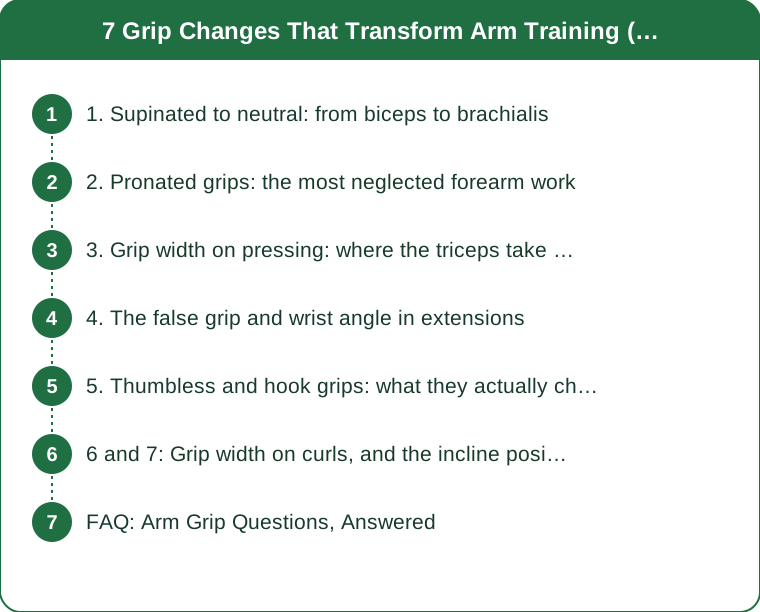
1. Supinated to neutral: from biceps to brachialis
The single most useful grip change in arm training, and the one most likely to break a plateau.
Supinated (palms up) is the classic curl grip. It puts the biceps brachii in its strongest position because the biceps both flexes the elbow and supinates the forearm.
Neutral (palms facing each other) - the hammer curl - reduces the biceps’ mechanical advantage and shifts more work to the brachialis, which sits underneath the biceps, and the brachioradialis in the forearm.
Why it matters: the brachialis is a pure elbow flexor with a larger cross-sectional area than most people expect, and developing it pushes the biceps upward, which contributes to arm thickness from the side. It’s chronically undertrained because nearly all curl variations are supinated.
How to apply it: if you currently do three sets of supinated curls, make one of them a hammer curl. Expect to use similar or slightly heavier weight - the neutral grip is often stronger.
A useful variation: the cross-body hammer curl, bringing the dumbbell toward the opposite shoulder, which increases brachialis emphasis further.
2. Pronated grips: the most neglected forearm work
Pronated (palms down) curls - reverse curls - are the least popular and among the most valuable.
This grip puts the biceps at a genuine mechanical disadvantage, which means the brachioradialis and the wrist extensors take the load. Expect to use dramatically less weight, often 40-50% of your supinated curl, and don’t let that discourage you.
What it gives you:
- Forearm development, particularly the muscle mass on the thumb side of the upper forearm
- Grip strength carryover to pulling movements
- Wrist extensor strength, which is protective against the elbow pain that shows up in people who grip a lot - climbers, racquet players, and anyone who does high-volume pulling
How to program it: 2 sets of 12-15 at the end of an arm session, twice a week. This is a supporting movement, not a main lift, and higher reps suit it.
Form note: keep the wrists straight rather than letting them drop. A collapsed wrist under a reverse curl is where the elbow discomfort comes from.
3. Grip width on pressing: where the triceps take over
In any pressing movement, moving your hands closer together shifts load from the chest and shoulders toward the triceps.
The close-grip bench press or close-grip push-up is one of the best triceps builders available, and it lets you load the triceps far heavier than any isolation movement can.
Practical widths:
- Wide grip: more chest, less triceps, more shoulder stress for many people
- Shoulder width: balanced, and the most joint-friendly for most
- Close grip (hands roughly 20-30cm apart): substantially more triceps
- Diamond push-up: the bodyweight equivalent, and genuinely hard
The mistake to avoid: going so narrow that your wrists are forced into extreme extension. Hands touching is not better than hands 20cm apart, and it puts the wrist in a position it can’t handle under load.
A simple substitution: replace one set of triceps extensions with a set of close-grip push-ups. You’ll load more total muscle for the same time investment.

4. The false grip and wrist angle in extensions
In triceps extensions - overhead, skullcrushers, pushdowns - wrist position determines whether the triceps or your forearms limit the set.
A straight, neutral wrist transmits force cleanly and lets the triceps be the limiting factor.
An extended (bent back) wrist puts the load on the wrist joint and the forearm flexors, and it’s why many people report wrist pain from skullcrushers and conclude the exercise doesn’t suit them.
Fixes:
- Use an EZ bar or dumbbells rather than a straight bar for skullcrushers. The angled grip lets the wrist sit neutral
- For pushdowns, try a rope attachment and let the wrists rotate naturally as you extend
- Grip the bar lower in the palm - closer to the heel of the hand rather than up in the fingers - so the load sits over the forearm bones rather than levering the wrist back
Overhead versus down: overhead extensions put the long head of the triceps in a stretched position, which is where the strongest hypertrophy stimulus tends to be. If you only do pushdowns, you’re mostly missing the long head - and that’s the head that fills out the back of the arm.
5. Thumbless and hook grips: what they actually change
Thumbless (false) grip removes the thumb from around the bar. In pressing, some people find it lets the forearm sit more directly under the bar; in pulling, it reduces biceps involvement slightly and shifts emphasis to the back.
Where it’s useful:
- Pulldowns and rows, where wrapping the thumb encourages you to pull with the arms rather than the back. Thumbless can help you feel the lats
- Not on a barbell over your face. A thumbless grip on a bench press or skullcrusher is a genuine injury risk, and it’s not worth the marginal benefit
Hook grip and mixed grip matter mainly for heavy pulling rather than arm training, but they’re worth knowing because grip failure often ends a set before the target muscle does.
The broader point for arm training: if your grip gives out first on rows and pulldowns, your back and arms never reach their limit. Straps are legitimate for this purpose - they’re not cheating, they’re removing the wrong limiting factor from a movement that wasn’t meant to train grip.
Train grip deliberately and separately if you want it, with hangs and carries.
6 and 7: Grip width on curls, and the incline position
6. Curl grip width changes the emphasis between biceps heads
The biceps has two heads, and grip width changes their relative contribution.
- Wide grip (hands outside shoulders) on a barbell or EZ bar emphasises the short head, on the inner side of the arm
- Narrow grip (hands inside shoulders) emphasises the long head, on the outer side - the one that contributes most to the visible peak
The difference is modest but real, and rotating between them across a training block is more useful than doing the same width for a year.
7. Arm position beats grip in one specific case
The most underrated arm training variable isn’t grip at all - it’s where your elbow sits relative to your torso.
- Elbows behind the body (incline dumbbell curl) puts the long head of the biceps in a stretched position, which is a strong hypertrophy stimulus and produces a very different feel from a standing curl
- Elbows in front of the body (preacher curl) emphasises the bottom range and the short head, and removes the ability to cheat with body swing
- Elbows at the side (standing curl) is the middle ground
A complete arm session uses all three positions, which is a more meaningful variation than doing three different curls all with the elbows at your sides. Incline curls in particular are chronically underused, and most people find them humbling with weights they curl easily standing.
FAQ: Arm Grip Questions, Answered
Should I change grips every session or every block?
Keep a grip for four to six weeks so you can progress the load, then change. Changing every session means you never know if you’re getting stronger.
Does grip width change forearm size?
Pronated and neutral work develops the forearm extensors and brachioradialis noticeably. Supinated curls alone develop the forearm very little.
Why do my wrists hurt on curls?
Usually a straight bar forcing the wrist into a fixed angle it doesn’t like. Switch to an EZ bar or dumbbells, which let the wrist find its own rotation, and the problem usually disappears entirely.
How many grip variations should be in one session?
Two or three is plenty. One supinated, one neutral or pronated, and one pressing movement for triceps covers the whole arm without turning a 25-minute session into an hour.
TL;DR:
- Supinated for biceps, neutral for brachialis, pronated for forearms - use all three
- Close-grip pressing loads triceps heavier than any isolation movement can
- Keep wrists neutral in extensions; use an EZ bar or dumbbells to allow it
- Thumbless grip helps on pulls, never on anything over your face
- Elbow position - incline, preacher, standing - varies the stimulus more than grip width does
Seven grip changes give you seven different exercises from the equipment already in front of you. That’s a longer runway than most people’s dumbbell rack provides.
Keep Reading
This article is for general informational and styling purposes only. Fit, sizing, and product availability may vary.