7 Elbow Pain Mistakes That Quietly Ruin Arm Training
Quick Answer: Most training-related elbow pain comes from grip choice, load progression speed, and volume rather than from any single bad exercise. The biggest offenders are straight-bar curls on stiff wrists, skull crushers with a fixed grip, adding weight faster than tendons adapt, training arms hard on consecutive days, and skipping the forearm work entirely. Switching to neutral or EZ-bar grips and slowing progression fixes the majority of cases.
You did not injure yourself doing anything dramatic. The elbow just started aching during curls, then during everyday things, and now the programme you liked is on hold.

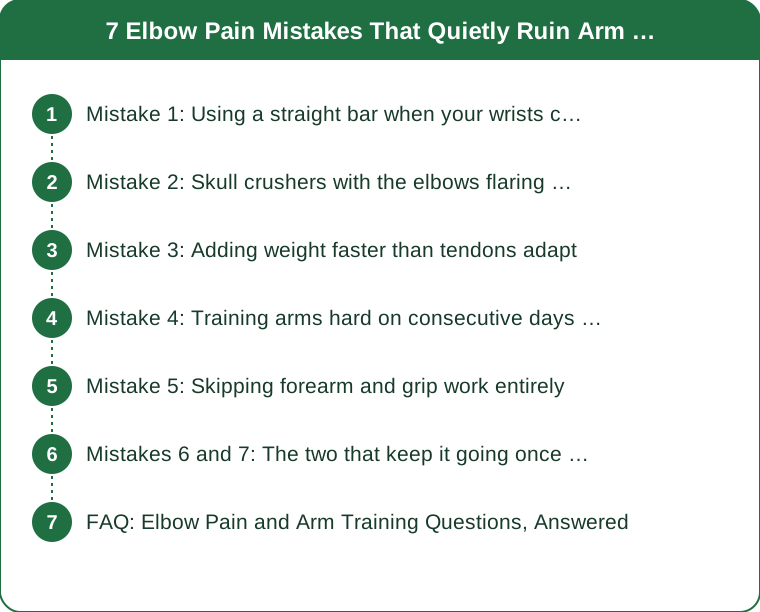
Mistake 1: Using a straight bar when your wrists cannot supinate freely
The straight-bar curl locks your forearms into full supination - palms fully up - for the whole movement. If your wrists and forearms do not comfortably reach that position, the strain lands at the elbow instead.
Why it hurts: with the grip fixed, any restriction in forearm rotation is absorbed by the soft tissue at the elbow, particularly on the inner side. Add load and repetitions and you get medial elbow irritation - sometimes described as golfer’s elbow.
How to tell if this is you: hold your arms out, elbows bent at 90 degrees, and turn your palms fully upward. If one or both wrists resist, or you have to angle your wrist to get there, a straight bar will be a problem for you.
The fix:
- Switch to an EZ bar, which allows a semi-supinated grip - typically the single most effective change anyone with elbow pain makes
- Use dumbbells, which let each forearm find its own rotation
- Try hammer curls with a neutral grip for a few weeks; they load the biceps and brachialis with almost no rotational stress at the elbow
- Keep the wrist straight and stacked, not curled back under the load
What to expect: many people find pain reduces within one to two weeks of the grip change alone, with no reduction in load or volume. If it does not, the cause is further down this list.
Mistake 2: Skull crushers with the elbows flaring and a fixed grip
Skull crushers are an effective triceps exercise with a well-earned reputation for elbow pain, and there are two separate reasons why.
The grip. A straight bar fixes the wrists in pronation while the elbows do the work, and the fixed position concentrates stress at the elbow through a long lever.
The elbow position. Elbows flaring outward as you lower the weight changes the line of pull and increases stress at the joint. This almost always happens as the set gets hard, which is why it is the last few reps that hurt.
The fixes, in order:
- Use an EZ bar or dumbbells rather than a straight bar
- Keep the elbows pointing forward, roughly shoulder-width, and do not let them drift outward
- Lower to behind the head rather than to the forehead, which reduces the elbow-only stress and gets more triceps stretch
- Replace them with cable overhead extensions for a block - the cable maintains tension without the same peak stress at end range
- Consider close-grip presses for a few weeks, which build triceps with much less elbow load
A useful principle: any triceps exercise where the elbow is the only moving joint and the load is heaviest at full elbow flexion is going to be demanding on the joint. Cables, which change the resistance curve, are gentler for the same stimulus.
Mistake 3: Adding weight faster than tendons adapt
This is the underlying cause behind most of the others, and it is invisible while it is happening.
Muscle adapts faster than tendon. Muscle tissue is well supplied with blood and responds to training within weeks. Tendon has much lower blood flow and remodels considerably more slowly. So your muscles can handle a load that your tendons are not yet ready for - and the gap is where tendinopathy develops.
The pattern: you add weight every session because the muscle can do it. Three or four weeks later the elbow starts aching. Nothing acute happened; the tendon simply never caught up.
The fix - slow the progression on arm work specifically:
- Increase load on isolation arm exercises no more than every two to three weeks, not every session
- Progress reps first, then load - go from 8 to 12 reps at the same weight before adding any
- Keep increments small: 1 to 2kg on a curl, not 5
- If you have had elbow pain before, hold a weight for four weeks before increasing
Why this feels too slow: because it is slower than your muscles can handle, and that is the point. Arms are a small-muscle group where the load is carried through relatively small tendons, so they need a more patient progression than legs or back.
And use tempo instead of load. A 3-second lowering phase at the same weight increases the stimulus meaningfully without increasing peak tendon stress. It is the best trade available for anyone with a sensitive elbow.

Mistake 4: Training arms hard on consecutive days without noticing
Most people do not schedule arms two days in a row. They do it accidentally, because arms are involved in almost everything.
Where the hidden volume comes from:
- Pull-ups, rows, and lat pulldowns all load the biceps substantially
- Presses, dips, and push-ups all load the triceps substantially
- Grip-intensive work - carries, deadlifts, kettlebells - loads the forearm muscles that cross the elbow
So a Monday arm session followed by a Tuesday back session followed by a Wednesday chest session is three consecutive days of meaningful elbow load, even though only one day says arms on the plan.
The fix:
- Audit your week honestly and count every exercise loading the elbow, not just the isolation work
- Aim for at least 48 hours between sessions that heavily load the same elbow tissue
- Place direct arm work on the same day as the compound work that hits the same muscles, rather than the day before or after
- Watch total weekly sets: 10 to 16 sets per arm muscle group per week, including the compound contribution, is plenty for most people
A simple restructure that works: biceps work after back day, triceps work after chest or press day, and one full rest day for the elbows between those two. Same total volume, half the accumulation.
Mistake 5: Skipping forearm and grip work entirely
The muscles that move your wrist and fingers attach at the elbow, on both sides. Weakness or poor conditioning in those muscles is one of the most consistent findings in people with elbow pain, and almost nobody trains them.
Why it matters: the common extensor tendon on the outside of the elbow and the common flexor tendon on the inside are where lateral and medial elbow pain live. Those tendons belong to forearm muscles. Strengthening the muscle improves the tendon’s tolerance, which is the actual mechanism behind most successful elbow rehab.
What to add - 5 minutes, twice a week:
Wrist extension, with a light dumbbell. Forearm supported on a bench, palm down, lower the weight slowly over 3 seconds then lift. 15 reps, 2 to 3 sets, starting with 1 to 2kg. The slow lowering is the important part.
Wrist flexion. Same setup, palm up. 15 reps, 2 to 3 sets.
Pronation and supination. Hold a light dumbbell by one end, forearm supported, rotate slowly palm-up to palm-down. 12 to 15 each way.
Dead hangs or farmer carries. 30 seconds, two or three sets, for general grip and forearm endurance.
Start light and progress slowly - these are small muscles with small tendons and the same patience rule applies. Two sessions a week is enough, and it is the most commonly skipped piece of a working arm programme.
Mistakes 6 and 7: The two that keep it going once it starts
Mistake 6: Training through pain because it warms up
Elbow tendon pain has a characteristic and misleading pattern: it hurts at the start of a session, eases as you warm up, and returns worse a few hours later or the next morning.
That warming-up is not healing. It is a normal response of an irritated tendon to load, and it is the single most common reason people continue training on a problem for months.
The rules that let you keep training without making it worse:
- Pain during a set at 3 out of 10 or below, that settles within 24 hours and does not worsen session to session, is generally acceptable to work with
- Pain above 4 out of 10, pain that lingers past 24 hours, or pain that is worse each session means reduce load and change the exercise
- Morning stiffness getting worse week to week is a clear signal to back off, regardless of how the session felt
- Never push through sharp or catching pain, or any pain with swelling, locking, or pins and needles
What to do instead of stopping entirely: switch to a pain-free grip, drop the load by 30 to 50 percent, slow the tempo, and keep training. Complete rest often feels better short term and tends to leave the tendon less tolerant when you return - loaded, gradual work is what most current guidance supports.
Mistake 7: Never changing the exercise selection
Doing the same three curls and two extensions every week for a year means the same tissue takes the same stress in the same range, thousands of times.
Vary these deliberately every 6 to 8 weeks:
- Grip: supinated, neutral, pronated
- Elbow position: in front of the body (preacher), at the side, behind (overhead)
- Resistance type: dumbbells, cables, bands - each has a different resistance curve and peak-stress point
Rotating exercise selection spreads the load across slightly different tissue and ranges, which is one of the more reliable ways to keep training arms hard without accumulating a single-point overuse problem.
If elbow pain persists beyond a few weeks despite these changes, or you have numbness, weakness, or night pain, get it assessed properly. This is general information, not medical advice.
FAQ: Elbow Pain and Arm Training Questions, Answered
Should I stop training arms completely if my elbow hurts?
Usually not. Current guidance for tendon pain favours modified loading over complete rest - a pain-free grip, reduced load, and slower tempo. Total rest often feels better briefly and leaves the tendon less tolerant on return.
How long does training-related elbow pain take to settle?
With the right modifications, many people improve noticeably in 4 to 6 weeks and substantially by 12. Tendons remodel slowly, so improvement measured in weeks rather than days is normal rather than a bad sign.
Do elbow sleeves or straps help?
A compression sleeve helps some people feel more comfortable and adds warmth. A counterforce strap can reduce symptoms for lateral elbow pain in the short term. Neither addresses the cause, so treat them as support alongside the changes above rather than a fix.
Are bands gentler on elbows than dumbbells?
Often, because band resistance is lowest where the joint is most flexed and highest near the end of the movement, which shifts peak stress away from the vulnerable position. They are a good option during a flare-up.
TL;DR:
- Switch straight bars for EZ bars or dumbbells - grip choice is the highest-return single change
- Keep elbows forward on triceps work and lower behind the head rather than to the forehead
- Progress arm load every two to three weeks, reps before weight, and use a 3-second lowering instead
- Count the hidden elbow volume in rows, presses, and carries when planning the week
- Add 5 minutes of wrist extension, flexion, and rotation work twice a week
- Pain that eases as you warm up is not healing - work under 3 out of 10 and change the exercise above it
- Rotate grip, elbow position, and resistance type every 6 to 8 weeks
Elbow pain is rarely caused by one bad exercise. It is the predictable result of small tendons being progressed at muscle speed, loaded from three directions in a week, and never given any direct forearm work. Fix those three things and the programme you liked usually comes back within a month.
Keep Reading
This article is for general informational and styling purposes only. Fit, sizing, and product availability may vary.