7 Arm Exercises You Are Almost Certainly Doing at the Wrong Tempo
Quick Answer: Most arm exercises are performed far too quickly on the lowering phase, which is where the majority of muscle-building tension actually happens. Slowing the eccentric (lowering) portion to 3 seconds while keeping the lifting phase controlled and deliberate transforms seven common exercises without adding a single kilogram.
You’ve been doing the same arm exercises for months with the same weight and the same result. Before adding load - which is the reflexive answer - look at tempo. It’s the variable almost nobody adjusts, and for arms specifically it’s often the one that’s limiting everything.

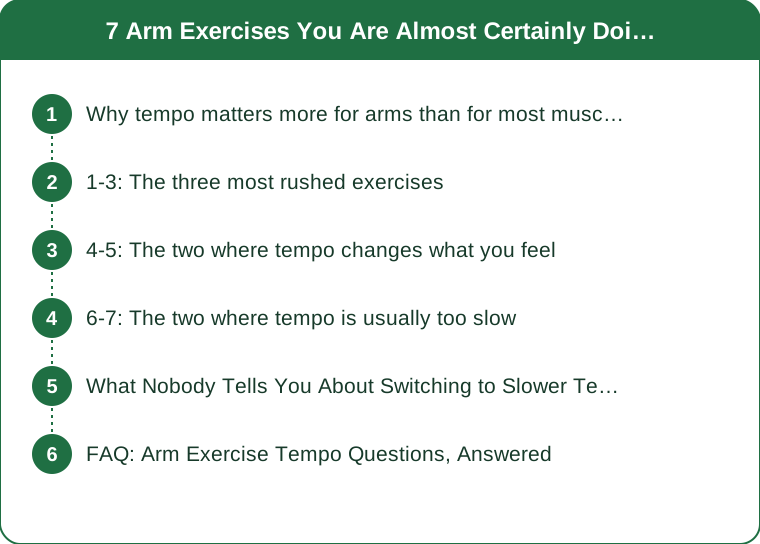
Why tempo matters more for arms than for most muscle groups
The biceps and triceps are relatively small muscles working through single-joint movements, which makes them unusually easy to move with momentum rather than muscle.
On a squat, momentum can only help you so much - the load is heavy relative to your capacity and the movement is long. On a bicep curl with a moderate dumbbell, a small swing at the shoulder and a fast drop on the way down can remove a surprising share of the actual work.
The eccentric phase is where this matters most. Lowering a weight under control - the eccentric contraction - is where muscle experiences high tension and mechanical stress, and it’s the phase most commonly rushed. Dropping the weight in half a second means the muscle spent almost no time producing force in that phase.
A useful frame: if you can perform a set at your normal weight with a 3-second lowering phase and it feels dramatically harder, you weren’t training as hard as you thought - you were letting gravity do a third of the work.
The notation used below: a tempo like 2-1-3-0 means 2 seconds lifting, 1 second pause at the top, 3 seconds lowering, 0 pause at the bottom.
1-3: The three most rushed exercises
1. Bicep curl - target tempo 2-1-3-0
What most people do: 1 second up, immediate drop down. Total time under tension per rep: about 1.5 seconds. What to do instead: 2 seconds lifting, brief squeeze at the top, 3 full seconds lowering. Total: 6 seconds per rep - four times the tension. The tell: if your dumbbell makes a sound when it reaches the bottom, you dropped it. Expect to reduce weight by 20-30% when you first do this properly. That’s not a step backwards; it’s an accurate measurement of what you were actually lifting.
2. Tricep pushdown - target tempo 2-1-3-0
What most people do: push down fast, let the cable snap the arms back up. Why it matters here specifically: the return phase is the eccentric for the triceps, and letting a cable pull your forearms up removes it entirely. This is the single most commonly wasted eccentric in the gym. What to do instead: resist the return over 3 full seconds. The set will feel completely different by rep six.
3. Overhead tricep extension - target tempo 2-0-3-0
What most people do: bounce at the bottom, using the stretch to rebound into the next rep. Why it matters: the stretched position at the bottom is where the long head of the triceps is under most tension - bouncing through it skips the most productive part of the movement. What to do instead: 3 seconds down, stop, then lift deliberately with no bounce. Shoulder comfort matters here; if the overhead position is uncomfortable, a lying variation works with the same tempo.
4-5: The two where tempo changes what you feel
4. Hammer curl - target tempo 2-1-4-0
Why a longer eccentric here: the hammer grip emphasises the brachialis and brachioradialis, which respond well to time under tension and are frequently underdeveloped relative to the biceps. What most people do: treat it as a variation to blast through after regular curls, at speed, when already fatigued. What to do instead: a 4-second lowering phase, and consider doing them first in the session rather than last. Most people have never trained this muscle group when fresh. The visible difference: brachialis development sits under the biceps and pushes it upward - it’s a significant contributor to arm shape that speed training tends to miss.
5. Skull crusher - target tempo 3-0-3-0
Why slow both ways: this is an exercise where fast movement genuinely increases elbow joint stress, and where control matters for safety, not just effectiveness. What most people do: lower quickly and press back explosively, often with elbows flaring outward. What to do instead: 3 seconds each direction with elbows held in a fixed position pointing at the ceiling. Reduce the weight substantially for the first few sessions. Stop if: you feel a sharp or pinching sensation at the elbow, which is worth having assessed rather than working through. This is general information, not medical advice.

6-7: The two where tempo is usually too slow
Tempo isn’t always about slowing down. Two common arm exercises are frequently performed too slowly, for different reasons.
6. Push-up - target tempo 3-0-1-0 (slow down, fast up)
Why fast on the way up: the pressing phase of a push-up benefits from an intent to move quickly, which recruits fast-twitch fibres and trains power. A grindingly slow push-up trains a different quality than most people want from it. What to do instead: 3 seconds lowering with full control, then push up with genuine speed intent. This asymmetric tempo - slow eccentric, fast concentric - is one of the more effective patterns available. Note: the aim is intent to move fast, not sloppy form. If speed breaks your position, regress to knees and keep the tempo.
7. Resistance band curl or pushdown - target tempo 2-1-3-0, but with a caveat
The band-specific issue: band resistance increases as the band stretches, meaning the hardest point is at full contraction and the easiest at full extension. A very slow eccentric on a band spends most of its time in the easy range. What to do instead: keep the 3-second eccentric but focus your attention on the first half of it, where the band is still under meaningful tension. Alternatively, add a 2-second hold at peak contraction, where band tension is highest. Why bands still earn their place: the peak-contraction emphasis is genuinely different from free weights and complements dumbbell work rather than replacing it.
What Nobody Tells You About Switching to Slower Tempos
Your weights will drop, sometimes a lot. A 30% reduction is normal when adding a 3-second eccentric properly. People who refuse to reduce the weight simply revert to the old tempo within two sets without noticing.
Soreness increases substantially for 2-3 weeks. Eccentric-heavy training produces more delayed-onset muscle soreness than concentric-heavy training. Expect it, reduce volume for the first fortnight, and don’t interpret it as injury.
You’ll need fewer reps. A set of 8 at 6 seconds per rep is 48 seconds of tension - well within productive range. Trying to keep both the old rep count and the new tempo produces sets that are too long to maintain quality.
Counting is harder than it sounds. People consistently count fast when a set gets difficult. Use a timer or count out loud for the first few sessions until the pace calibrates.
Not every set needs to be slow. A reasonable structure is slow tempo for the first two sets of an exercise and normal controlled tempo for the last, which lets you accumulate volume without every set being maximally demanding.
Progress tracking changes. Your logbook needs a tempo column, or the weight numbers become meaningless. A 10kg curl at 3-second eccentric is a different exercise from a 10kg curl at half a second.
FAQ: Arm Exercise Tempo Questions, Answered
How long before I see a difference from changing tempo?
Strength changes are often noticeable within 3-4 weeks; visible change follows the usual timeline of 8-12 weeks with consistent training and adequate protein.
Is slower always better?
No - very slow tempos (5+ second phases) limit the total load you can use, and load matters too. The 2-3 second range for the eccentric captures most of the benefit without sacrificing weight.
Should I use slow tempo for every arm exercise every session?
Mixing is usually better. Slow tempo on some sets, normal controlled tempo on others, gives you both time under tension and total volume.
Does tempo matter as much for compound lifts?
It matters, but less dramatically - momentum contributes proportionally less on heavy compound movements. Arms are where tempo has the biggest effect precisely because the loads are lighter.
Will slower training make me bulky?
Muscle growth depends on total training stimulus, nutrition, and time - not on tempo specifically. Changing tempo changes how effectively a given exercise loads the muscle, not what kind of result it produces.
TL;DR:
- The lowering phase is where most arm-training tension lives, and it’s the phase most commonly rushed
- Target 2-1-3-0 for most arm exercises - 2 up, brief squeeze, 3 down
- Expect to drop 20-30% of your weight when doing it properly; that’s an accurate measurement, not a setback
- Push-ups are the exception: slow down, fast up
- Band exercises need a peak-contraction hold rather than a long eccentric
- Add a tempo column to your logbook or the weight numbers stop meaning anything
You probably don’t need heavier dumbbells. You need slower ones. This is general information, not medical advice.
Keep Reading
This article is for general informational and styling purposes only. Fit, sizing, and product availability may vary.