7 Arm Exercises That Look Effective but Barely Do Anything — and What to Do Instead
Quick Answer: Tiny pulsing movements, excessively light weight for high reps, exercises done with momentum instead of control, and moves that isolate a muscle already well-trained by daily life all look effective but contribute little real stimulus — swapping toward moderate load and full range of motion fixes most of them.
‘It burns, so it must be working’ is one of the most common and most misleading assumptions in arm training. Several extremely popular exercises produce a strong burning sensation with a relatively small actual training stimulus, and it’s worth knowing which ones so effort goes toward what actually builds tone.

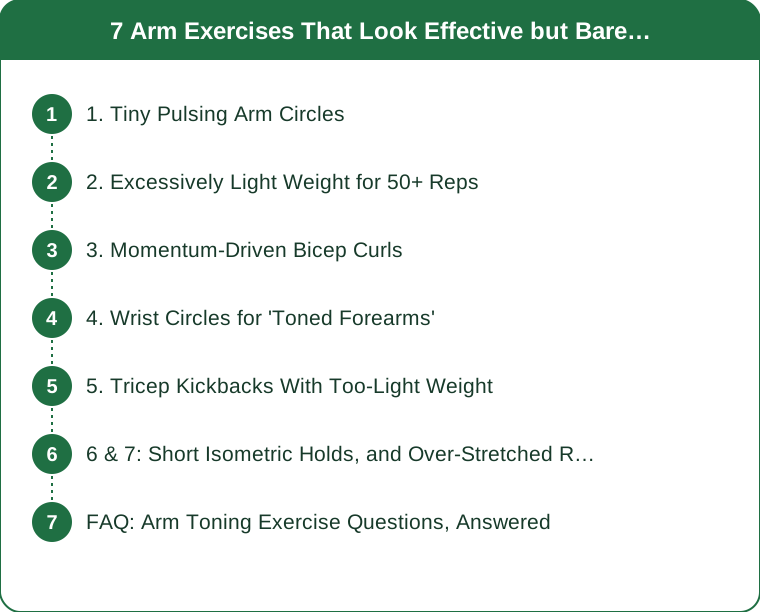
1. Tiny Pulsing Arm Circles
The burn is real but mostly from local fatigue and blood flow restriction in a very small range of motion, not meaningful muscle-building tension.
Swap: Full range-of-motion lateral raises with light-to-moderate dumbbells target the same shoulder area with far more actual mechanical stimulus.
2. Excessively Light Weight for 50+ Reps
Very light dumbbells for extremely high reps mostly builds muscular endurance in that specific movement, not the strength or visible tone most people are actually after.
Swap: A weight that becomes genuinely challenging by rep 12-15 in a set of 3, allowing real progressive overload over weeks.
3. Momentum-Driven Bicep Curls
Swinging the weight up using back and shoulder momentum removes tension from the bicep during exactly the phase that matters most for growth.
Swap: Slow, controlled curls with a 2-second lowering phase — the eccentric portion is where a large share of the actual muscle-building stimulus happens.

4. Wrist Circles for ‘Toned Forearms’
This targets small stabilizer muscles with minimal loading capacity, producing negligible visible change regardless of rep count.
Swap: Farmer’s carries or dead-hangs with moderate-to-heavy weight build genuine forearm and grip strength far more effectively.
5. Tricep Kickbacks With Too-Light Weight
This is a commonly under-loaded exercise — the position itself is mechanically weak, so a weight that’s ‘light enough to feel controlled’ is often too light to matter.
Swap: Overhead tricep extensions or close-grip pushups load the triceps more effectively through a stronger mechanical position.
6 & 7: Short Isometric Holds, and Over-Stretched Resistance Bands
6. Isometric Arm Holds Under 15 Seconds
Very short holds mostly train the nervous system to sustain a position briefly rather than building meaningful muscular endurance or strength.
Swap: Holds of 30-45 seconds, or better, moderate-load dynamic reps, which produce more measurable strength adaptation over time.
7. Resistance Band Work With a Fully Stretched-Out Band
An old, over-stretched resistance band loses tension throughout the range, meaning the ‘hardest’ part of many exercises barely resists at all.
Swap: Replace bands showing visible stretch-out or reduced snap-back, or move to dumbbells for more reliable, consistent resistance.
FAQ: Arm Toning Exercise Questions, Answered
Is the burning sensation ever a reliable sign an exercise is working?
Not on its own — burn can come from blood flow restriction or minor local fatigue without meaningful mechanical tension, which is what actually drives strength and tone changes.
How do I know if my weight is heavy enough for arm exercises?
If you can easily do more than 15-20 reps with good form, the weight is likely too light for meaningful strength stimulus — the last 2-3 reps of a set should feel genuinely challenging.
Do I need to completely stop doing these 7 exercises?
Not necessarily — most can still have a place as a warm-up or finisher, but they shouldn’t be the primary driver of an arm-toning routine if visible results are the goal.
TL;DR:
- Burn alone doesn’t confirm an exercise is effective — mechanical tension and range of motion matter more
- Swap tiny pulses and momentum-driven reps for controlled, full range-of-motion movement
- Weight should be genuinely challenging by rep 12-15, not just ‘light enough to feel controlled’
- These 7 exercises aren’t useless, but shouldn’t be the primary driver of a toning routine
Feeling worked and being effectively worked aren’t the same thing — matching the exercise to real mechanical stimulus is what actually changes results.
Keep Reading
This article is for general informational and styling purposes only. Fit, sizing, and product availability may vary.