From Wall to Floor: The Pushup Journey Every Woman Can Take
Quick Answer: The pushup is a four-rung ladder, not a pass-fail test: wall pushups (15 reps), counter pushups (15 reps), knee pushups (10 reps), then full pushups. Move up a rung when you can hit the rep target with clean form. Most women get to their first full pushup in six to twelve weeks of practising two or three times a week.
Somewhere in gym class, the pushup got turned into an exam — one you took in front of everyone, and probably failed.
That framing is the problem. The pushup isn’t a test of whether you’re strong. It’s a ladder with four rungs, and the bottom rung is a wall.
Yes, a wall. It counts, it works, and it’s teaching your body the exact same movement pattern as the version on the floor.

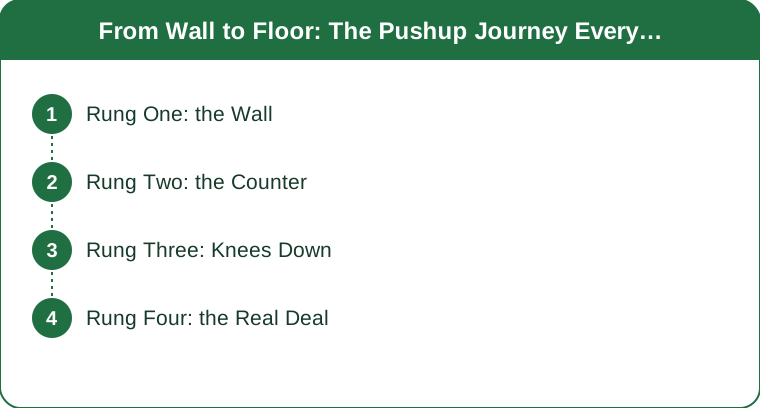
Rung One: The Wall Pushup
Stand about two feet from a wall, hands flat at chest height and slightly wider than your shoulders. Body in one straight line from head to heels. Lean in until your chest nearly touches, then press away.
Target: 15 clean reps.
It looks too easy. It isn’t wasting your time — it’s teaching the entire blueprint: a braced plank position, elbows tracking back at roughly 45 degrees rather than flaring to the sides, and a full press through the hands.
Form check: if your hips drop or your lower back arches, you’ve lost the plank. Squeeze your glutes and brace your abs as if bracing for a poke in the stomach.
Rung Two: The Counter Pushup
Same movement, hands on a kitchen counter or a sturdy table. Lower angle, more load — roughly 40-50% of your body weight versus about 25% at the wall.
Target: 15 smooth reps.
Progress by lowering the surface over time: counter → desk → sturdy chair → bottom stair. Each drop in height is a small, manageable increase in difficulty, which is far more useful than jumping straight to the floor.
Form check: shoulders directly over hands at the bottom, and the whole body moving as one piece.

Rung Three: The Knee Pushup
Floor at last. Knees down, hands under shoulders, and — this is the part everyone gets wrong — a straight line from head to knees. Hips forward, not piked up. This is a pushup, not a tent.
Target: 10 controlled reps.
Put a cushion under your knees if the floor is unkind. Lower until your chest is a few inches off the ground, pause briefly, and press.
Form check: if you can’t see your hands in your peripheral vision at the bottom, your hands are too far forward.
Rung Four: The Full Pushup
Full plank, hands under shoulders, body rigid from heels to head. Lower until your chest hovers just above the floor. Press.
Target: one rep.
One is not a consolation prize. One is the summit flag. Then it’s two, then five, and the ladder never cared how long any rung took.
The useful in-between: negatives. Start at the top of a full pushup and lower yourself as slowly as you can — aim for 5 seconds — then drop to your knees to get back up. Three to five of these is the single fastest bridge between rung three and rung four.
5 Mistakes Everyone Makes Learning Pushups
- Flaring the elbows to 90 degrees. Elbows should track back at roughly 45 degrees from your body. Full flare puts the shoulder joint in a vulnerable position and makes the movement harder than it needs to be.
- Piking the hips on knee pushups. Hips up means your arms are doing much less work. Straight line from head to knees, always.
- Half reps. A shallow pushup builds a shallow pushup. Full range at an easier rung beats partial range at a harder one every time.
- Rushing up the ladder. Skipping a rung because it feels too easy is how people plateau. Earn the rep target with clean form before you move.
- Only training pushups. Rows and band pull-aparts build the back and shoulder stability that a strong pushup sits on. Two or three sets, twice a week, and the pushup improves faster.
How Should You Program It?
Frequency: 2-3 times a week, with a rest day between sessions.
Volume: 3 sets at your current rung, stopping 1-2 reps short of total failure.
Progression: add 1-2 reps per set each week. When you hit the target for all three sets, move to the next rung — and expect your reps to drop sharply. That’s correct, not a setback.
Realistic timeline: starting from wall pushups, most women reach their first full pushup somewhere between six and twelve weeks. Starting from knee pushups, often four to six.
Mini FAQ
Why are pushups harder for women?
Largely a distribution difference — upper-body muscle mass tends to be a smaller proportion of total mass, so the same movement represents a higher relative load. It’s a starting-point difference, not a ceiling, and it responds to training exactly like anything else.
How long does it take to do a full pushup?
Six to twelve weeks of consistent practice from a wall or counter start, two to three sessions a week. Progress is faster if you’re also doing some rowing or pulling work.
Are knee pushups actually useful?
Yes — they’re a legitimate strengthening exercise, not a lesser version. The one thing to watch is keeping the body straight from head to knees, because a piked hip position removes most of the load.
TL;DR:
- Four rungs: wall (15 reps) → counter (15 reps) → knees (10 reps) → full pushup (1 rep).
- Keep a straight line from head to heels (or knees) and let elbows track back at about 45 degrees.
- Use negatives — 5-second lowers from the top — to bridge from knee pushups to full ones.
- Train it 2-3 times a week, 3 sets, stopping just short of failure.
- Expect six to twelve weeks from the wall to your first full rep. One rep is the summit, not a starting point.
Keep Reading
This article is for general informational and styling purposes only. Fit, sizing, and product availability may vary.