Farmer Carries: The Arm Exercise Disguised as Errands
Quick Answer: A farmer carry is simply walking tall while holding something heavy in each hand — and you already do a version of it every time you haul groceries in from the car. Doing it on purpose, with good posture and a bit of structure, turns an everyday errand into real training for your grip, arms, shoulders, and core.
You already do farmer carries — you just call it taking the groceries in one trip. The strength world caught on and made it official: carrying heavy things while walking tall is elite-tier training for arms, grip, shoulders, and core. Errands were the gym all along; nobody just labeled it that way.

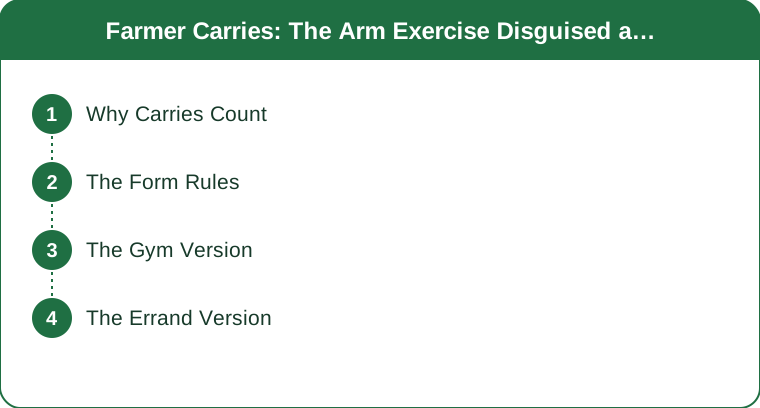
What exactly is a farmer carry?
A farmer carry is exactly what it sounds like: you pick up a weight in each hand — dumbbells, kettlebells, or grocery bags all work — and walk with it, keeping your posture tall and controlled the whole time. It’s one of the simplest exercises that exists, which is part of why it’s so effective and so easy to sneak into an ordinary day.
Why do farmer carries count as real training?
Holding weight while moving forces your arms, grip, and core to negotiate constantly with every step, in a way that a stationary exercise like a bicep curl just doesn’t demand. Your grip has to fight the weight pulling down, your core has to resist leaning to one side, and your shoulders have to stay stacked over your hips the whole way.
Grip strength in particular shows up again and again in general health and longevity research — which is a fairly compelling scientific endorsement of the one-trip grocery rule you were already following out of laziness.
What’s the correct form for a farmer carry?
Form is most of the exercise here, and it’s simpler than it looks:
- Stand tall, shoulders back and down — no shrugging up toward your ears.
- Let the weights (or bags) hang quiet at your sides, not swinging.
- Walk like you own the hallway — even, controlled steps.
- No leaning to compensate for a heavier side, and no waddling to make the walk easier.
Posture really is half the exercise here, and arguably all of the aesthetic — a good farmer carry looks almost boringly controlled, which is exactly the point.

How do you do farmer carries as an actual gym exercise?
Grab two dumbbells, walk for 30-45 seconds, and repeat for three rounds, usually tacked on at the end of a workout. It’s a satisfying way to finish a session because it hits grip, arms, shoulders, and core all at once when you’re already warmed up.
When it starts feeling easy:
- Go heavier with the same two-handed setup, or
- Switch to a single-arm carry — the lopsided load forces your core to work overtime just to stay upright and level.
Either progression keeps the exercise challenging without needing new equipment or a complicated program.
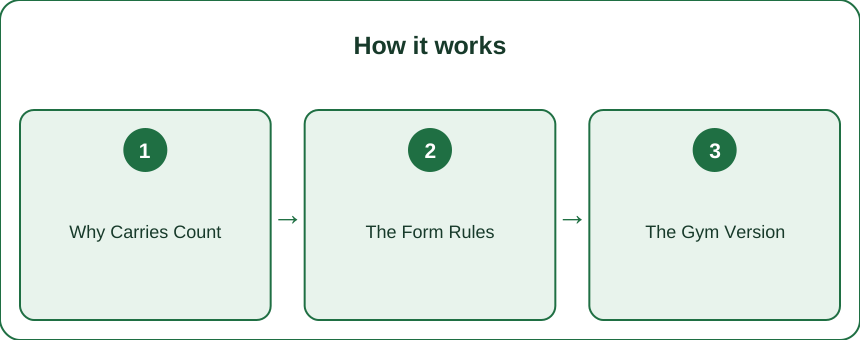
How do you turn errands into a farmer carry workout?
Keep the bags balanced in both hands, spine tall, pace controlled — the walk from car to kitchen is a full set whether you think about it that way or not. Two trips with light bags is more of a cardio warm-up; one proud, heavy, well-carried trip is genuine strength work. Choose your discipline for the day based on how your body’s feeling.
What Nobody Tells You About Farmer Carries
- Your forearms will be sore before anything else — grip fatigue usually shows up a day or two before you notice shoulder or core soreness.
- Uneven loads are harder than they look. A single heavy bag on one side recruits your obliques way more than two evenly split bags.
- Walking surface matters. A carry across gravel or an uneven driveway is a slightly different (harder) exercise than one across smooth flooring.
- It’s a great “no excuses” exercise — no machine, no space requirement, and it fits into a day you’re already having.
- If you have a pre-existing back, shoulder, or grip injury, it’s worth checking with a doctor or physical therapist before loading up heavy carries, since poor form under load is where most tweaks happen.
Mini FAQ
How heavy should a farmer carry be?
For general strength and grip work, a common approach is choosing a weight per hand that’s challenging by the last 10-15 seconds of a 30-45 second walk. Heavier isn’t automatically better if it wrecks your posture — controlled form matters more than the number on the dumbbell.
Are farmer carries good for grip strength?
Yes — farmer carries are one of the most straightforward ways to train grip strength, since your hands have to maintain tension the entire time you’re walking, not just for a brief peak effort like a single lift.
Can you do farmer carries with just groceries?
Absolutely. Balanced grocery bags, a couple of gallon water jugs, or filled duffel bags all work as informal farmer-carry weights. The exercise cares about tall posture and controlled walking far more than it cares about matching dumbbells.
TL;DR
- A farmer carry = walking tall while holding a heavy weight in each hand.
- It trains grip, arms, shoulders, and core simultaneously — a rare combo for one simple move.
- Gym version: two dumbbells, 30-45 seconds, three rounds.
- Progress by going heavier or switching to a single-arm carry.
- Good form (tall spine, quiet weights, no leaning) matters more than heavy weight.
- Everyday grocery hauls are a legitimate version of the exercise — just keep the load balanced and your spine tall.
- Check with a doctor or physical therapist first if you have an existing back, shoulder, or grip injury.
Keep Reading
This article is for general informational and styling purposes only. Fit, sizing, and product availability may vary.