Toned Arms With Only Light Dumbbells: Making 5 to 10 Pounds Actually Work
Quick Answer: Light dumbbells build real arm strength and shape if - and only if - sets approach genuine fatigue. Research is clear that lighter loads taken close to failure produce muscle growth comparable to heavy training; the catch is that means 15 to 30 real reps, not stopping at 12 because a video said so. The tools that make 5 to 10 pounds feel heavy: slow lowering phases, pauses at the hardest point, shortened rest, and single-arm work. Effort is the ingredient; the dumbbells are just the delivery system.
The light-dumbbell arm workout has a terrible reputation, earned by a thousand routines where nothing was ever difficult. The weights were never the problem. The stopping point was.

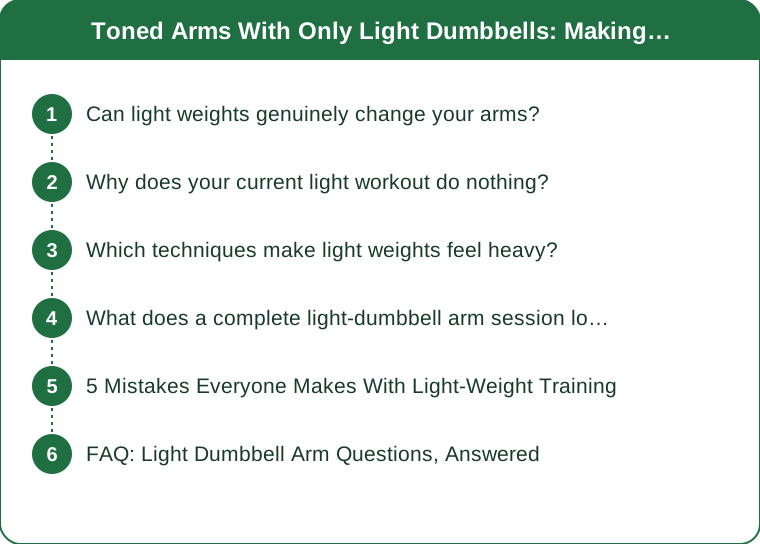
Can light weights genuinely change your arms?
Yes - and this is settled enough in the research that the interesting question has moved on to how.
Multiple controlled studies over the past decade have compared heavy-load training (weights you can lift 6 to 12 times) against light-load training (weights liftable 20 to 35 times), with both groups taking sets close to failure. The repeated finding: muscle growth is essentially equivalent when effort is matched. Heavier loads build maximal strength somewhat faster - the skill of lifting big things - but for muscle shape and tone, the arm does not know what the dumbbell weighs. It knows how hard its fibers had to work at the end of the set.
The mechanism is recruitment: early reps of a light set use a fraction of your muscle fibers, and as those fatigue, the body recruits more - until the final hard reps of a long set have nearly everything working, which is the same end-state a heavy set reaches quickly.
The catch that invalidates most living-room routines: close to failure means the last two or three reps are genuinely difficult - slowing down involuntarily, requiring focus, arriving within a few reps of the point you could not continue with good form. A set of 12 easy curls with a 5-pound dumbbell recruits little, signals nothing, and changes nothing - and that set, repeated three times a week for years, is where the light weights do not work belief comes from.
So the entire project is manufacturing honest difficulty from small numbers. Every tool below is a difficulty multiplier.
Why does your current light workout do nothing?
Four structural habits, all inherited from routines designed around convenience rather than adaptation:
Stopping at an arbitrary rep count. Ten or twelve reps is a tradition from heavy training, where twelve is hard. With a light dumbbell, rep twelve is a warm-up rep. The set should end near genuine difficulty - for light loads that is typically somewhere between 15 and 30 reps, and the honest number varies by day and exercise.
No progression anywhere. Muscles adapt to what they have already handled. If January and August feature the same weights, reps, tempo, and rests, August is maintenance - pleasant, but not change. Something must ratchet: reps, tempo, range, density.
Momentum doing the middle of every rep. Light weights swing easily, and a swinging curl is a rest disguised as a rep - the muscle works briefly at the bottom, coasts through the middle, and catches at the top. This is also why light-weight training gets called toning-not-building: performed with momentum, it is neither.
Resting like it is heavy training. Two-minute scrolls between light sets let recruitment reset completely, so every set starts from zero difficulty. Light training earns its effect partly through accumulated fatigue - short rests are a feature.
None of these are effort failures; they are design failures, and the fix is not trying harder at the same routine. It is a routine where difficulty is built in - which is the toolkit.
Which techniques make light weights feel heavy?
Five multipliers, roughly in order of value:
1. Slow the lowering phase. Muscles are strongest lowering and weakest lifting - so spend time where the strength is. Lift in one count, lower in three to four deliberate counts. A 3-second lowering curl with 8 pounds produces more muscular tension per rep than a swung 15-pound curl, and it is kinder to elbows.
2. Pause at the hardest point. One to two seconds at the position of maximum difficulty - halfway up a curl, arms at shoulder height in a lateral raise, elbows-bent bottom of an overhead press. Pauses delete momentum and force the fibers to hold, not just pass through.
3. Finish with partials. When full reps become impossible near the set’s end, continue with half-range reps in the hardest zone until those fail too. Three to five closing partials convert a decent set into a complete one - this is the classic burn everyone remembers from barre-style classes, and it is legitimate.
4. Go one arm at a time. Unilateral work lets full attention and effort concentrate on one side, removes the stronger arm quietly assisting, and doubles time under tension per session at zero cost.
5. Compress the rest. 30 to 45 seconds between sets, or pair opposing movements back-to-back - curls into overhead extensions - so one muscle rests exactly while the other works. Fatigue carried between sets is the point.
Rule for combining them: pick one or two per exercise, not all five at once - the goal is honest difficulty you can progress, not a single unrepeatable heroic Tuesday.

What does a complete light-dumbbell arm session look like?
Twenty-five minutes, twice a week, pairs of opposing exercises, minimal equipment drama:
Pair 1 - biceps and triceps:
- Slow curls: lift 1 count, lower 4 counts. Set ends within 2 reps of form failure - expect 12 to 20.
- Immediately: overhead triceps extensions, both hands on one dumbbell, same tempo, same endpoint.
- Rest 45 seconds. Three rounds.
Pair 2 - shoulders:
- Lateral raises with a 2-second pause at the top. These get hard fast even at 5 pounds - expect 10 to 18 honest reps, plus 3 to 5 partials in the bottom half after full reps fail.
- Immediately: bent-over reverse flys, slow lowering, for the rear shoulders that mirrors ignore and posture loves.
- Rest 45 seconds. Three rounds.
Pair 3 - the press and the finisher:
- Single-arm overhead press, non-working hand on hip, 3-count lowering. Each arm to near-failure.
- Immediately: hammer-grip curls, both arms, half-range only in the hardest middle zone until they genuinely stop.
- Rest 60 seconds. Two rounds.
Notes that keep it working: warm up with one easy set of each pair first; write down reps achieved (the notebook is the progression system); expect a deep burn - that is the accumulated recruitment, not damage. Sharp joint pain, especially at the elbow or the front of the shoulder, is a form or volume signal to respect rather than push through. This is general information, not medical advice.
5 Mistakes Everyone Makes With Light-Weight Training
Mistake 1: Counting reps instead of judging effort. The set is over when the last reps are genuinely slow and difficult - some days that is rep 14, some days rep 24. A fixed target turns half your sets into rehearsals.
Mistake 2: Speeding up as it burns. The burn triggers an instinct to rush through remaining reps with momentum - which removes tension exactly when the set was about to pay. When it burns, slow down. That is the entire craft.
Mistake 3: Training arms daily because the weights are light. Light does not mean recovery-free; sets near failure create real fatigue in muscle and tendon. Two, at most three, arm-focused sessions weekly with a day between beats the daily-burnout cycle that ends most living-room programs by week five.
Mistake 4: Never progressing anything. Each week, nudge one dial: two more reps, one more second of lowering, five fewer seconds of rest, one extra round. The dumbbells staying the same is fine forever - the demands cannot.
Mistake 5: Dismissing results because the weights sound small. People perform months of honest light training, see visible change, and still buy heavier dumbbells out of embarrassment rather than need. The fourth mistake stalls bodies; this one stalls minds. A 20-rep pause-lateral-raise set that leaves your shoulders shaking is hard training by any definition the muscle recognizes - the muscle, fortunately, cannot read the label.
FAQ: Light Dumbbell Arm Questions, Answered
How long until I see a difference in my arms?
With two honest sessions weekly: strength and endurance climb within 3 to 4 weeks (the notebook shows it first), visible firmness commonly lands in the 8 to 12 week range, and meaningful shape change is a season, not a month. The variables that predict success are proximity to failure and consistency - not the number printed on the dumbbell.
Will light weights make my arms bulky?
No training makes arms accidentally bulky - visible muscle size builds slowly and deliberately at any load, and the light-load route is if anything the gentler slope. What light training near failure reliably produces is the firmer, defined look most people mean by toned.
Are 3-pound dumbbells too light to bother with?
For lateral raises with pauses and partials, 3 pounds can be plenty. For curls and presses, most people outgrow 3s quickly even with every technique applied - reps drift past 30 and sets take forever. A 5, 8, and 10-pound trio covers years of arm training with these methods; adjustables cover it in one object.
Should I still buy heavier dumbbells eventually?
If a movement exceeds about 30 honest reps with your heaviest pair despite slow tempo and pauses, a step up saves time - fifteen hard reps and thirty hard reps build similarly, but thirty takes twice as long. Buy time efficiency when you need it, not legitimacy. The training was already legitimate.
TL;DR:
- Light loads taken close to failure build muscle comparably to heavy training - effort is the active ingredient
- Close to failure means the last 2 to 3 reps are genuinely hard, usually landing between 15 and 30 reps
- The multipliers: 3 to 4 count lowering phases, pauses at the hardest point, closing partials, single-arm work, 30 to 45 second rests
- Progress one dial weekly - reps, tempo, rest, or rounds - and log it; the notebook is the program
- Two or three sessions a week with recovery days beats daily burnout; expect visible change around 8 to 12 weeks
The 5-pound dumbbell was never the obstacle - the polite set of twelve was. Take the same small weights to honest difficulty with slow negatives and pauses, and the living-room workout quietly starts doing what the gym membership promised.
Keep Reading
This article is for general informational and styling purposes only. Fit, sizing, and product availability may vary.