7 Real Reasons Your Arms Aren't Changing (It's Rarely the Exercises)
Quick Answer: Arms usually don’t change due to insufficient progressive overload, too little training volume, skipping compound pulling movements, or expecting spot reduction — not from picking the wrong isolation exercises.
You’ve tried different curl variations, switched up rep ranges, even bought new dumbbells, and your arms look the same as 6 months ago. Here are the 7 real reasons, roughly in order of how often they’re the actual culprit.

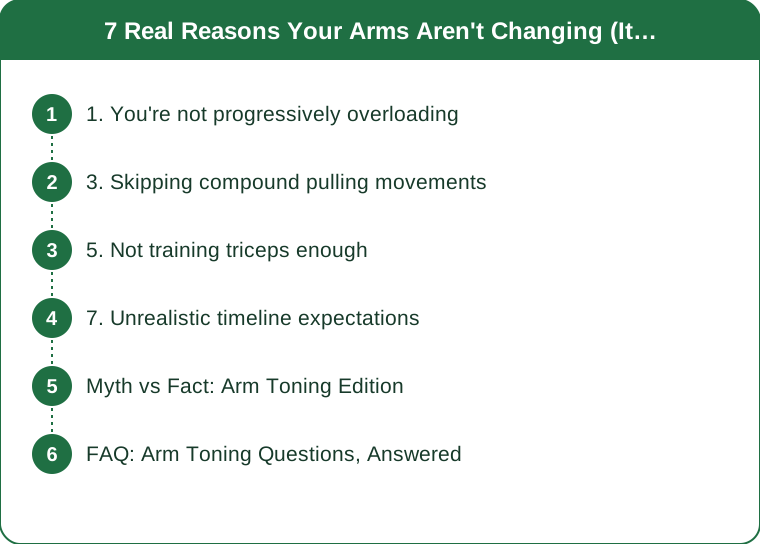
1. You’re not progressively overloading
Using the same 8lb dumbbells for 6 months gives your muscles no new reason to adapt. Arms respond to progressive overload just like any other muscle group — track your weights and reps, and aim to add either every 2-3 weeks, even in small increments.
2. Not enough total volume
One set of curls at the end of a workout, twice a week, isn’t enough stimulus for visible change. Research on muscle growth generally points to needing multiple sets across the week per muscle group — 6-10 total weekly sets for biceps and triceps each is a more realistic target than the 2 sets many routines default to.
3. Skipping compound pulling movements
Rows and pull-ups engage biceps significantly as secondary movers, and back-and-arm supersets often build more visible arm size than isolation work alone. An arm routine built entirely from isolation exercises misses this compound contribution entirely.
4. Expecting spot reduction
No amount of tricep extensions will reduce fat specifically on the arms — fat loss happens across the whole body based on overall caloric balance, not the muscle you’re currently training. Toned, defined arms need both muscle work and appropriate overall body fat levels.
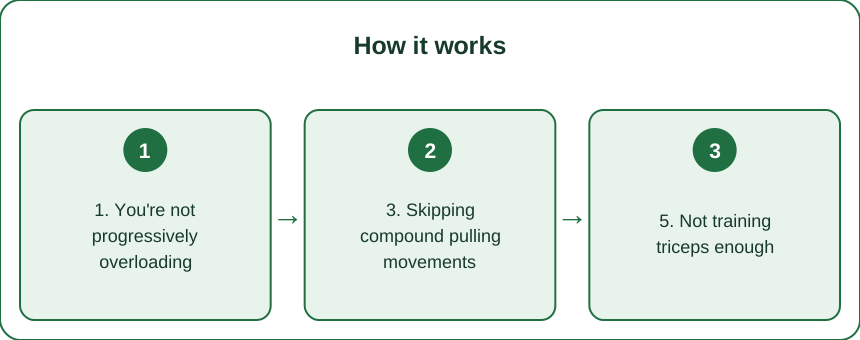
5. Not training triceps enough
Triceps make up roughly two-thirds of upper arm mass, more than biceps — a routine overloaded with curls and light on tricep work is training the smaller portion of the arm more than the bigger one. Pushdowns, overhead extensions, and close-grip presses deserve at least equal volume to bicep work.
6. Recovery gaps
Training arms hard every single day without rest actually slows growth — muscle adaptation happens during recovery, not during the workout itself. 48 hours between arm-focused sessions is a reasonable minimum.

7. Unrealistic timeline expectations
Visible arm changes from a new or intensified routine typically take 8-12 weeks of consistent training to show clearly, not 2-3 weeks. Many people quit or switch programs right before changes would have become visible.
Myth vs Fact: Arm Toning Edition
Myth: Light weights with high reps ‘tone’ while heavy weights ‘bulk.’ Fact: Muscle definition comes from a combination of muscle size and lower body fat — rep range affects strength and endurance adaptations more than the tone-vs-bulk myth suggests.
Myth: Doing arm exercises every day speeds up results. Fact: Daily training without recovery slows adaptation — muscles need 48 hours to rebuild after a real training stimulus.
FAQ: Arm Toning Questions, Answered
How long does it take to see visible arm changes?
Most people see initial changes around 8-12 weeks of consistent progressive training with adequate volume — faster with a caloric deficit if fat loss is also part of the goal.
Should I focus more on biceps or triceps?
Triceps, since they make up a larger share of upper arm size — a 1:1 or even 2:1 tricep-to-bicep volume ratio builds more visible arm change than a curl-heavy routine.
Can I ‘tone’ arms without building muscle?
Definition requires some muscle development alongside appropriate body fat — ‘toning’ without any muscle-building stimulus isn’t a distinct physiological process.
TL;DR:
- Progressive overload and enough total weekly volume matter more than exercise choice
- Compound pulling movements (rows, pull-ups) build real arm size too
- You can’t spot-reduce arm fat — overall body composition matters
- Triceps need equal or greater volume than biceps
- Give any new routine 8-12 weeks before judging results
The exercises were probably never the real problem — volume, overload, and patience usually are.
Keep Reading
This article is for general informational and styling purposes only. Fit, sizing, and product availability may vary.