7 Reasons Your Arm Workout Isn't Working Like It Used To
Quick Answer: The same arm workout stops producing the same results over time due to adaptation, hormonal shifts, recovery capacity, and simple lack of progressive overload — not because your body has become resistant to exercise itself.
Doing literally the same routine and seeing different results isn’t in your head. Here are seven concrete reasons why, and what actually addresses each.

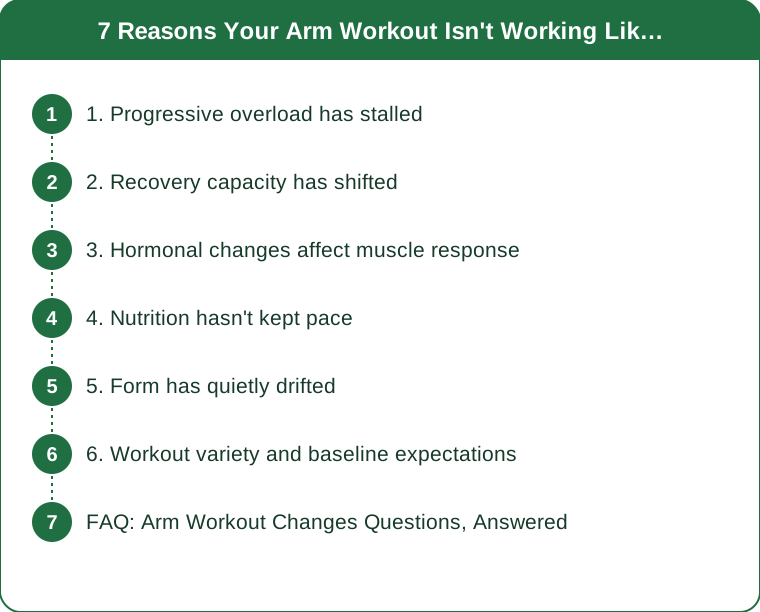
1. Progressive overload has stalled
If you’ve been lifting the exact same dumbbells for the exact same reps for months, your muscles have fully adapted and have no reason to keep changing — this is the single most common reason arm results plateau.
Fix: add small, regular increases — either weight, reps, or an extra set — every few weeks, even in small increments.
2. Recovery capacity has shifted
Sleep quality, stress levels, and overall life load all affect how well muscle actually repairs and grows between sessions — the same workout with worse recovery produces worse results, full stop.
Fix: if results have dropped alongside worse sleep or higher stress, that’s worth addressing before assuming the workout itself needs an overhaul.
3. Hormonal changes affect muscle response
Age-related and cycle-related hormonal shifts genuinely affect muscle protein synthesis and recovery, which changes how a given workout translates into visible results over time, particularly for women navigating perimenopause.
Fix: this doesn’t mean giving up on results — it often means adjusting volume, recovery time, or protein intake to match the current hormonal reality rather than an old baseline.

4. Nutrition hasn’t kept pace
Muscle maintenance and growth require adequate protein intake, and needs can shift with age, activity level, and goals — a diet that supported results a year ago might now be undersupporting them.
Fix: a rough target often cited is 0.7-1g of protein per pound of body weight for those focused on muscle maintenance or growth, spread across meals.
5. Form has quietly drifted
Small form breakdowns — using momentum instead of controlled muscle tension, shortening the range of motion over time — reduce the actual training stimulus even if the weight on the dumbbell looks the same.
Fix: periodically record yourself or work with a trainer to check form hasn’t drifted from what originally produced results.
6. Workout variety and baseline expectations
Muscles adapt to specific movement patterns, and doing curls in the exact same order, angle, and tempo indefinitely eventually produces diminishing returns even with progressive overload in place. Fix: rotate angles (incline curls, hammer curls, overhead extensions) every several weeks to keep providing a fresh stimulus.
7. Baseline expectations have shifted
Sometimes the workout is actually still working, but the visible or felt changes are smaller in absolute terms simply because you’re closer to your current genetic and training ceiling than you were a year ago — early results are always the fastest. Fix: track objective numbers (weight lifted, reps completed) rather than relying purely on visual comparison, since strength gains often continue even when they’re harder to see.
FAQ: Arm Workout Changes Questions, Answered
How often should I change my arm workout to avoid plateau?
A general guideline is reassessing and adjusting every 4-6 weeks — either weight, volume, or exercise variation — rather than running the exact same plan indefinitely.
Is it normal for results to slow down over time?
Yes — the fastest visible changes typically happen in the first several months of consistent training, with results becoming more gradual as you approach your current ceiling, which is completely normal.
Should I worry if my arms actually feel weaker than last year?
If it’s a sudden, unexplained drop rather than a gradual plateau, it’s worth ruling out factors like illness, major sleep disruption, or nutritional gaps before assuming it’s just training-related.
TL;DR:
- Stalled progressive overload is the most common reason for a plateau
- Recovery, hormones, and nutrition all genuinely affect how a workout translates into results
- Form drift and workout stagnation quietly reduce training stimulus over time
- Track objective numbers, not just visual comparison, since results naturally slow after early gains
This is general information, not medical advice — talk to a professional about significant, unexplained strength changes.
Keep Reading
This article is for general informational and styling purposes only. Fit, sizing, and product availability may vary.