7 Reasons Your Arm Workouts Have Stopped Working — Ranked by How Often They're the Real Cause
Quick Answer: The most common reasons arm training plateaus, in order of frequency: not progressively overloading, training the same rep range every session, insufficient recovery between sessions, poor mind-muscle connection, underestimating nutrition’s role, ignoring compound lifts, and unrealistic timeline expectations for visible change.
You’ve been consistent, you’re not skipping sessions, and your arms still look the same as 8 weeks ago. Here are the 7 most common reasons, ranked by how often each one turns out to be the actual cause.

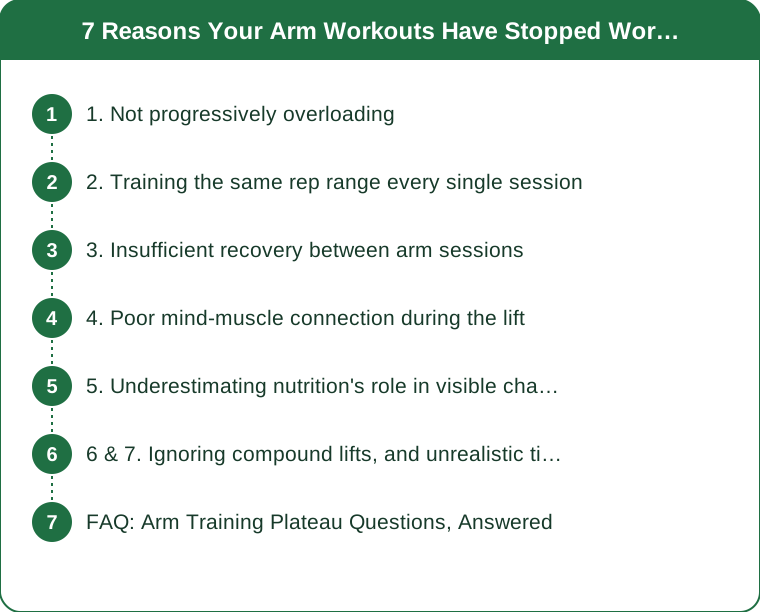
1. Not progressively overloading
By far the most common cause. If you’re lifting the same weight for the same reps you were doing a month ago, your muscles have no reason to keep adapting — they’ve already adapted to that specific stimulus and stopped changing. Progressive overload doesn’t have to mean heavier weight every week; more reps, slower tempo, or shorter rest between sets all count as legitimate progression.
2. Training the same rep range every single session
Muscles respond differently to different rep ranges — low reps for strength, moderate reps for hypertrophy, high reps for endurance. Sticking to one range exclusively for months means you’re only training one adaptation pathway, and that pathway eventually plateaus on its own regardless of effort.
3. Insufficient recovery between arm sessions
Arms are a smaller muscle group that recovers faster than legs or back, but they still need 48 hours minimum between direct training sessions for most people. Training arms directly (not just as secondary movers in other lifts) too frequently can mean you’re never fully recovered enough to progressively overload.

4. Poor mind-muscle connection during the lift
Going through the motion of a curl without actually feeling the target muscle work reduces the effective training stimulus, even at the same weight and reps. Slowing the eccentric (lowering) phase and consciously focusing on the working muscle measurably increases muscle activation in research on this specific technique.
5. Underestimating nutrition’s role in visible change
Visible arm definition requires both muscle development and a body fat percentage low enough to see it — training alone can’t override a calorie surplus that’s obscuring muscle you’ve actually built. If arms feel stronger but don’t look different, nutrition is a more likely gap than the training itself.
6 & 7. Ignoring compound lifts, and unrealistic timeline expectations
6. Ignoring compound lifts that indirectly build arms
Isolation exercises (curls, extensions) matter, but rows, presses, and pull-ups recruit arm muscles under heavier overall load than isolation work typically allows, contributing meaningfully to arm development that a curls-only routine misses.
7. Unrealistic timeline expectations for visible change
Meaningful visible muscle change realistically takes 8-12 weeks minimum of consistent progressive training, often longer. Expecting visible difference in 3-4 weeks sets up a false ‘plateau’ read on a timeline that was actually just too short to judge yet.
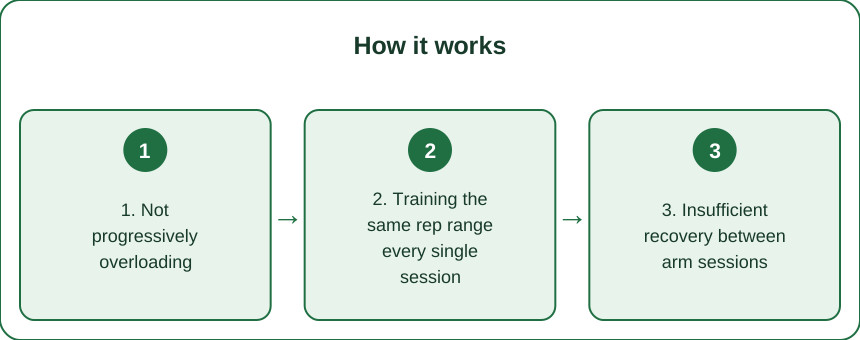
FAQ: Arm Training Plateau Questions, Answered
How do I know which of these 7 reasons applies to me?
Start with progressive overload — check your training log for the last month. If weight, reps, and rest haven’t changed, that’s very likely your primary answer before considering the others.
Do I need to change my whole routine to fix a plateau?
Usually not — addressing 1-2 of the top reasons (overload and rep range variation) resolves most plateaus without a full program overhaul.
How long should I give a change before judging if it worked?
At least 4-6 weeks of consistent application before evaluating — shorter than that isn’t enough time to distinguish a real plateau break from normal week-to-week variation.
TL;DR:
- Lack of progressive overload is the single most common plateau cause
- Vary rep ranges instead of training the same range every session
- Nutrition, not just training, gates visible definition
- Give any fix 4-6 weeks before judging whether it worked
Most plateaus resolve by fixing 1-2 of these, not overhauling the entire routine.
Keep Reading
This article is for general informational and styling purposes only. Fit, sizing, and product availability may vary.