7 Range-of-Motion Fixes That Do More for Your Arms Than Heavier Weights
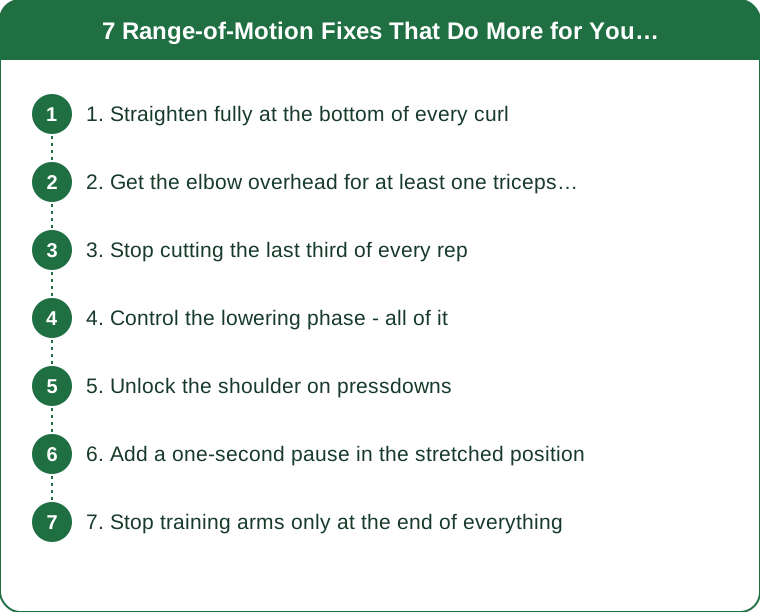
Quick Answer: Training through a full range - particularly the stretched, lengthened portion of each movement - produces more strength and size adaptation than partial reps at the same load, and the arms are where partials creep in most. Seven specific fixes: fully straighten at the bottom of curls, get the elbow overhead for triceps, stop cutting the last third of every rep, control the lowering phase, unlock the shoulder on pressdowns, add a stretch-position pause, and stop letting the last three reps shrink. None of them requires heavier dumbbells.
You added weight and nothing changed. The likeliest reason is that you added weight to a rep that was already only two thirds of a rep - and the third you have been skipping is the one that does most of the work.

1. Straighten fully at the bottom of every curl
The bottom of a curl is where the biceps is under load in its longest position, and the lengthened position is where the strongest growth signal appears in the research on range of motion. It is also the position people quietly abandon first, because it is the hardest and least satisfying part of the rep.
Watch for the elbow stopping around 20 or 30 degrees short of straight. This looks like a full rep in a mirror and feels like a full rep because the biceps stays tense throughout, which is exactly why it is so easy to keep doing.
The fix is a load reduction, not a cue. Drop the weight by 20 to 30 percent and straighten completely at the bottom of every single rep. Most people find their working weight on strict full-range curls is dramatically lighter than their partial-rep weight, and that is information, not failure.
One caveat: full extension under load means the elbow joint is loaded at end range. If you have elbow pain or a history of tendon issues, reach full extension without a bounce, and never drop into it - control the last few degrees.
Time cost: zero. Ego cost: real. This is the highest-return item on the list and the one most people skip twice before finally doing.
2. Get the elbow overhead for at least one triceps movement
The long head of the triceps crosses the shoulder joint, which means it only reaches its fully stretched position when the arm is overhead. Pressdowns, kickbacks, and close-grip presses all train the triceps, but none of them put the long head in that lengthened position.
This is the single most common gap in arm programs. People run three triceps exercises and all three keep the elbow at the side, which means the largest of the three heads never trains in its most productive range.
The fix is one overhead movement per session. An overhead cable extension, a seated dumbbell extension, or a lying extension taken behind the head all qualify. One is enough.
Go for the stretch, not the load. The value here is the position, so choose a weight that lets you get the elbows near your ears and lower well behind your head with control.
Watch the shoulder. If overhead positions bother your shoulder, an incline bench version with the torso reclined gets most of the same stretch with less shoulder demand.
3. Stop cutting the last third of every rep
Fatigue shortens range before it stops reps. Watch anyone’s set of twelve: reps one through six are full, seven through nine shorten slightly, and ten through twelve are half reps performed with total conviction.
The shortened reps at the end are the ones you needed most. The final reps of a set closest to failure are where the highest-threshold motor units are recruited, and shrinking the range at exactly that moment removes most of the value.
The fix: define the set by full reps, not by a number. If the target is twelve and rep nine is the last full one, the set is nine. Write down nine. Next week, aim for ten.
Use a physical marker. A bench you must touch, a fixed point on the wall in your eyeline, or a partner counting only full reps. Self-assessment during fatigue is unreliable in a very consistent direction.
Filming one set from the side per month is worth an hour of coaching. Almost everyone is surprised, and the surprise is always in the same direction.

4. Control the lowering phase - all of it
The eccentric, or lowering, phase is where a large share of the growth stimulus lives, and it is also where the range disappears fastest. A curl lowered in half a second is barely a lowering phase at all.
Aim for two to three seconds down on isolation work. Not four, not a slow-motion performance - just enough that the weight is being lowered rather than dropped.
Count out loud or in your head. Perceived tempo drifts fast when a set gets hard, and an internal count is the cheapest correction available.
Do not add tempo and keep the same load. A properly controlled eccentric makes a given weight substantially harder. Reduce the load, keep the reps, and accept that this is now a different and better exercise.
The bonus effect: slow eccentrics make partial reps physically obvious. It is very difficult to cheat range while lowering deliberately, so this fix quietly enforces the first three.
5. Unlock the shoulder on pressdowns
Triceps pressdowns turn into shoulder extensions when the elbow drifts back, which recruits the lat and shortens the effective range at the elbow. The set feels productive because you can use more weight, which is exactly the problem.
Pin the upper arm. The elbow should stay in one place beside the torso for the whole rep. If it travels backward at the bottom or forward at the top, the weight is too heavy.
Get full extension at the bottom without leaning. A forward torso lean converts the movement into a partial press. Stand close enough to the stack that you can stay upright.
And allow the full stretch at the top. Most people stop the upward phase at 90 degrees. Letting the forearm come up further, until the triceps is genuinely lengthened, adds range at the end that most sets never see.
A rope attachment usually allows more range than a straight bar, because the hands can separate at the bottom and the wrists are free to rotate.
6. Add a one-second pause in the stretched position
Pausing where the muscle is longest removes the stretch reflex, which means the muscle has to produce the force to start the rep rather than bouncing out of it. It also makes it physically impossible to shorten the range without noticing.
Apply it to one exercise per session, not all of them. Incline dumbbell curls at the bottom and overhead extensions at the bottom are the two best candidates in arm training, because both place the muscle in a deep stretch.
One second is enough. This is a control cue, not an endurance test, and longer pauses just reduce the load you can use without adding much.
Expect the weight to drop meaningfully. A paused incline curl is a genuinely humbling exercise, and it exposes exactly how much of a normal set was momentum.
Use it as a diagnostic once a month even if you do not program it weekly. If your paused weight is a fraction of your normal weight, your normal sets have a range or tempo problem.
7. Stop training arms only at the end of everything
Range collapses under accumulated fatigue, and arms are almost universally programmed last, after pressing and pulling have already fatigued the biceps and triceps as synergists. By the time you reach the curl, the tissue is pre-fatigued and your ability to control full range is reduced.
Try one session a week where arms come first. The quality difference in range and control is usually obvious within one session, and the load you can handle through a genuinely full range is typically higher.
Or separate them entirely. A short 15-minute arm session on an otherwise light day, done fresh, often produces better results than 25 minutes tacked onto the end of a hard back day.
Watch total elbow volume across the week. Rows and pulldowns train the biceps; pressing trains the triceps. If you are running high volume on both plus dedicated arm work, the limiting factor may be recovery rather than stimulus, and adding more range-of-motion work to an over-fatigued arm will not help.
The general principle behind all seven fixes: quality of range, controlled tempo, and freshness beat load increases for arm training in almost every case where progress has stalled. Load matters - but only applied to a rep that is actually a rep.
This is general information, not medical advice. Sharp elbow or shoulder pain during any of these adjustments is a reason to stop and check in with a professional rather than to push through.
TL;DR:
- Full range - especially the lengthened, stretched portion - drives more adaptation than partials at the same load, and arm training is where partials creep in first.
- Straighten fully at the bottom of curls and include one overhead triceps movement per session so the long head trains lengthened.
- Count only full reps, control a two to three second lowering phase, and pin the elbow on pressdowns.
- Add a one-second stretch-position pause on one exercise as both a training tool and a monthly diagnostic.
- Train arms fresh at least once a week instead of always last, since fatigue shrinks range before it stops reps.
You do not have an arm training problem, you probably have a rep-length problem. Fix the range first and you will find the weights you already own are heavier than you thought.
Keep Reading
This article is for general informational and styling purposes only. Fit, sizing, and product availability may vary.