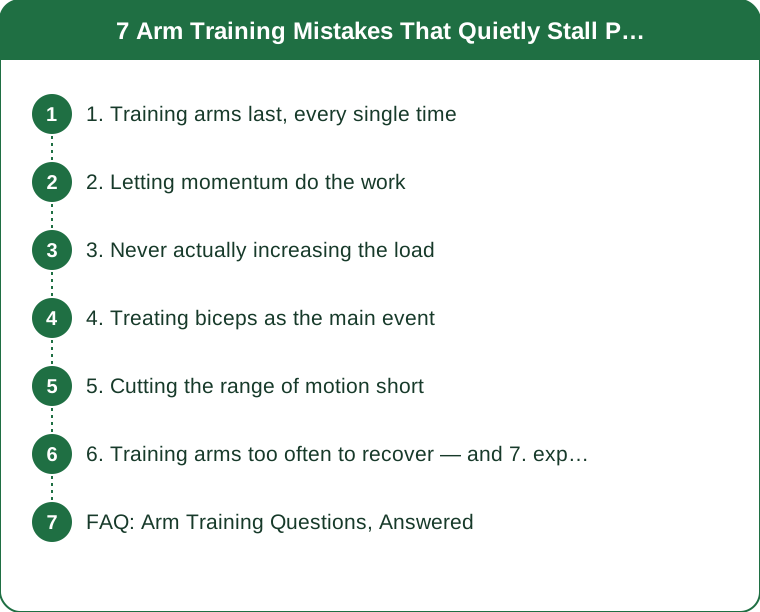
7 Arm Training Mistakes That Quietly Stall Progress
Quick Answer: The most common arm training errors are training them only at the end of exhausting sessions, using momentum instead of muscle, never progressing the load, neglecting triceps in favour of biceps, working through too small a range of motion, training arms too frequently to recover, and expecting definition from training alone when it is largely a body composition outcome.
Arms are among the most trainable muscle groups and among the most commonly stalled. Almost always the cause is one of a short list of correctable errors rather than genetics.

1. Training arms last, every single time
The default structure - big compound lifts first, arms at the end - is reasonable programming, and it becomes a problem when it never varies.
By the time you reach arm work after squats, presses, and rows, your available effort is depleted. The sets get shorter, the loads lighter, and the concentration worse. Over months, arms accumulate consistently low-quality volume while every other muscle group gets your fresh attention.
The fix is not to abandon compound-first structure. It is to give arms one priority slot per week:
- One session weekly where arms come first, straight after the warm-up
- Or a short standalone arm session of 20 minutes on a non-lifting day
- Or superset arms between compound sets, using rest periods productively
What to expect: the load you can use when fresh is often noticeably higher than at the end of a session. That difference, applied consistently, is a meaningfully greater training stimulus over a training block.
This is the single most common structural error, and it costs more than any exercise selection detail.
2. Letting momentum do the work
Arms are small muscles moving relatively light loads, which makes them unusually easy to cheat without noticing.
The classic tells:
- Swinging the torso to start a curl, so the initial movement comes from the hips and back
- Elbows drifting forward during curls, converting it partly into a front raise
- Bouncing at the bottom of a rep, using elastic recoil instead of muscular force
- Shoulders rolling forward on tricep pushdowns, so the chest and lats contribute
Why it matters: the muscle only adapts to tension it actually experiences. A curl performed with body English might move 12kg while the biceps experiences the equivalent of 8. You are training, just less than you think.
Fixes that work immediately:
- Back against a wall for curls. Impossible to swing. Most people drop the weight considerably, which tells you what was happening.
- A 3-second lowering phase on every rep. The eccentric is where a great deal of the growth stimulus lives, and it is what momentum eliminates entirely.
- Pause one second at the bottom, removing the bounce.
- Film one set from the side. Nothing else is as convincing.
Lighter weight with strict form outperforms heavier weight with swing, reliably, for arms specifically.
3. Never actually increasing the load
Muscles adapt to progressive overload. Arm training is where progression is most often abandoned, because the increments feel small and unglamorous.
People squat 60kg then 62.5kg then 65kg and track it carefully, then curl the same 8kg dumbbells for two years without noticing.
Why arms are especially prone to this: the available jumps are large in percentage terms. Going from 8kg to 10kg dumbbells is a 25 percent increase, which is a big step for a small muscle. Faced with that jump, people simply stay at 8kg.
How to progress when the jump is too big:
- Add reps first. 3 sets of 8 becomes 3 sets of 12 over a few weeks, then increase the weight and drop back to 8.
- Add a set. Three sets becomes four at the same weight.
- Slow the tempo. A 4-second lowering phase at the same weight is a genuine increase in stimulus.
- Reduce rest between sets from 90 to 60 seconds.
- Use fractional plates if you train with a barbell or adjustable dumbbells - 1.25kg increments make progression continuous.
Write down what you did. This is the actual fix. Almost nobody who logs their arm sets stays at the same weight for a year, and almost everyone who does not, does.

4. Treating biceps as the main event
The triceps make up roughly two-thirds of upper arm mass. Training biceps twice as much as triceps is training the smaller muscle harder.
The imbalance is understandable - biceps are visible in a mirror and easier to feel working - and it is the wrong allocation for both appearance and strength.
A balanced weekly structure:
- Triceps: 8 to 12 working sets per week
- Biceps: 6 to 10 working sets per week
Tricep exercises worth including, covering all three heads:
- Overhead extensions - the only common movement that properly loads the long head in a stretched position, and the most commonly missing exercise
- Close-grip press or dips - heavy compound loading
- Pushdowns - lateral and medial heads, easy to progress
- Skull crushers - a strong stretch under load
Bicep exercises worth including:
- Incline curls - long head in a stretched position
- Hammer curls - brachialis, which sits underneath and pushes the bicep up when developed
- Standard curls - straightforward loading
The brachialis point is underrated. It lies beneath the biceps, and developing it increases apparent arm size. Hammer curls and reverse curls train it, and most programmes barely touch it.
5. Cutting the range of motion short
Partial reps feel productive because you can use more weight and the burn is intense. They deliver less growth stimulus per set than full range.
Evidence increasingly favours training through a full range, with particular value in the stretched position of a movement. Muscles appear to respond strongly to loaded stretch, which is precisely the part people cut.
Where range gets shortened, specifically:
- Curls stopped halfway down, never reaching full elbow extension. The bottom portion is where the long head is most stretched.
- Pushdowns not fully locked out, missing peak contraction
- Overhead extensions with a short arc, avoiding the deep stretch that makes them valuable
- Bouncing out of the bottom rather than pausing under control
The correction costs you weight, and that is expected. Full range at 8kg is a better stimulus than partial range at 12kg. If lowering the weight bothers you, log it as a new exercise so you are not comparing against a number that was never fully earned.
Exception worth noting: deliberate partial reps at the end of a set, after full-range reps are exhausted, are a legitimate intensity technique. That is different from every rep being partial from the start.
6. Training arms too often to recover — and 7. expecting definition from training alone
Two errors that pull in opposite directions, and both are common.
Frequency and recovery. Arms are involved in nearly every upper body movement - rows, presses, pull-ups, everything. Adding four dedicated arm sessions on top of that leaves them with no recovery window.
Signs you are overdoing it: persistent elbow ache, strength dropping session to session, arms feeling permanently pumped but not changing, and grip fatigue during other lifts.
A sensible frequency: two dedicated arm sessions per week, on non-consecutive days, alongside your normal training. That is 6 to 12 sets per muscle per week, which is a well-supported range. Three sessions works for some, and four is beyond what most people recover from.
Elbow pain specifically is a signal to reduce volume and check technique rather than to push through. Tendon issues at the elbow are slow to resolve and easy to prevent.
7. Expecting definition from training alone
Visible arm definition is muscle size plus low enough body fat to see it. Training builds the muscle; it does not by itself reveal it.
This matters because it is the most common source of frustration in arm training. Someone trains diligently for six months, gains real strength, and sees limited visual change - then concludes the training failed. The training worked. The visibility depends on overall body composition, which is driven by total energy intake and total activity, not by arm exercises.
Spot reduction does not occur. Training a muscle does not preferentially reduce fat over it - a finding that has been tested repeatedly and consistently.
What actually helps: build the muscle with progressive training, manage overall nutrition, be patient, and use strength progress rather than mirror appearance as your primary measure. Strength gives feedback on a weekly timescale. Appearance gives feedback on a several-month timescale, and judging by it week to week is discouraging for no useful reason.
FAQ: Arm Training Questions, Answered
How long before arm training shows visible results?
Strength improvements appear within 2 to 4 weeks. Visible size changes typically take 8 to 12 weeks of consistent progressive training, and visible definition also depends on body composition, which moves on its own timeline.
Can I train arms every day?
Not productively. Muscle grows during recovery, and arms are already involved in most upper body work. Two dedicated sessions a week on non-consecutive days suits most people.
Are heavy weights or light weights better for arms?
Both work when sets are taken close to failure. A practical approach is heavier work in the 6 to 10 rep range for compound-style movements and lighter work in the 12 to 20 range for isolation, which is also easier on the elbows.
Do I need cables and machines, or are dumbbells enough?
Dumbbells and a resistance band cover almost everything. Cables offer more constant tension, which is a genuine advantage, but exercise selection variety matters far less than progression and consistency.
Why do my elbows hurt during curls?
Commonly technique, too much volume, or gripping too hard. Try a slower tempo, reduce weekly sets, and switch to a neutral grip such as hammer curls. Persistent pain warrants a physiotherapist rather than working through it. This is general information, not medical advice.
TL;DR:
- Give arms one fresh, prioritised slot a week instead of always training them exhausted
- Eliminate momentum: wall-supported curls, 3-second lowering, one-second pauses, and film a set
- Progress deliberately - add reps, sets, tempo, or fractional weight, and write it down
- Triceps are two-thirds of arm mass, so give them more sets than biceps and include overhead work
- Train full range, especially the stretched position; partial reps at heavier weight are a poor trade
- Two sessions a week is enough, and definition depends on body composition, not on more arm exercises
Arms are not a stubborn muscle group. They are usually an under-progressed, over-cheated, and under-recovered one, and each of those is fixable inside a single training block.
Keep Reading
This article is for general informational and styling purposes only. Fit, sizing, and product availability may vary.